
China · Professional qualifications
What Professional Qualifications Can Foreigners Take in China? Start With the Chinese CPA
Foreigners can take China’s CPA exam under specific rules. Explore the 2026 eligibility, exam cities, Chinese-language barrier, free study resources and career limits.
Foreign nationals cannot take every Chinese professional qualification exam. But some important qualifications are open to them — and the Chinese CPA is one of the most interesting examples.
In October 2026, a dispute over the legal credentials of new White House press secretary Katie Zacharia put an unusual question into the news. Asked where she had passed a bar exam, Zacharia referred to the time when she moved to China. Current reporting has not established that she passed a bar exam in China or in a U.S. jurisdiction.
For anyone thinking about earning a professional qualification in China, the more useful point is this: China’s 2026 National Unified Legal Professional Qualification Examination requires Chinese nationality. An ordinary foreign national therefore cannot simply apply for China’s legal qualification exam.
But that does not mean Chinese professional qualifications are generally closed to foreigners.
Some are. Some are not.
And for several qualifications, the more useful question is not simply:
“Am I allowed to take this exam?”
It is:
“Would this qualification actually be worth the time it takes me to earn it?”
For the first article in this series, we are starting with one of the clearest and most substantial examples: the Chinese Certified Public Accountant examination, usually called the Chinese CPA or CICPA exam.

First, a quick map: what can foreigners take?
There is no single rule covering every Chinese professional qualification.
Guangzhou, for example, published an updated 2026 directory containing 41 professional qualification examinations open to overseas persons. But “overseas persons” is a broad category, and every qualification still has its own eligibility rules.
So treat such lists as a map of possibilities, not as a promise that every foreign passport holder can take every exam.
A few representative examples:
| Qualification | Can an ordinary foreign national take it? | The important catch |
|---|---|---|
| Chinese CPA | Yes | China has a specific foreign-candidate route. The examination is essentially in Chinese. |
| Computer and Software Professional Qualification | Yes, under the stated rules | Eligible overseas candidates may apply under the national and local rules. Check the notice for your work or residence location. |
| Chinese physician qualification | Yes, through specific routes | The conditions are much stricter and can depend on where the medical degree and required supervised training were completed. |
| National legal professional qualification | No for ordinary foreign nationals | Chinese nationality is required. |
| National tour-guide qualification | No for ordinary foreign nationals | The national examination requires PRC citizenship. |
| Ordinary primary and secondary teacher qualification | No for ordinary foreign nationals | Chinese nationality is required; Hong Kong, Macao and Taiwan residents have separate arrangements. |
That is why asking:
“Can foreigners take Chinese professional exams?”
is usually too broad.
You need to ask about the specific qualification.
The Chinese CPA: foreigners really can take it
China does not merely accept foreign candidates informally.
The Chinese Institute of Certified Public Accountants — CICPA / 中国注册会计师协会 — publishes a separate annual registration guide specifically for Hong Kong, Macao and Taiwan residents and foreign nationals.
Under the 2026 rules, a foreign national with full civil capacity can apply for the professional stage if they meet either of these conditions:
- they have a qualification at junior-college level or above recognized by the relevant Chinese education authorities; or
- they already hold a CPA qualification, or another corresponding professional qualification, recognized under foreign law.
A candidate can enter the comprehensive stage only after passing the professional stage.
If your degree was awarded outside China and you are not sure whether it will be accepted, do not guess. First-time foreign candidates submit their diploma or relevant professional qualification documents through the registration system for qualification review.
If there is any doubt, contact the examination agency for the location you plan to use before paying the examination fee.
One timing warning
As of Oct. 15, 2026, the 2026 registration and examination dates have already passed.
Registration ran from Apr. 7 to Apr. 30, 2026. The main professional and comprehensive examinations were held on Aug. 29–30, 2026.
The 2026 rules are still useful because they show how the current foreign-candidate system works.
But if you are preparing for 2027, wait for CICPA to publish the new annual guide before assuming the dates, fees or procedures will be identical.
Registration is national and online
You do not normally begin by walking into a local CPA association office.
Foreign candidates register through the national CPA Examination Online Registration System — 注册会计师全国统一考试网上报名系统 — or through CICPA’s official WeChat account.
The process has three main parts:
- register and enter your information;
- complete qualification review;
- pay and confirm the application.
First-time foreign candidates submit their identity and qualification documents online.
The local CPA association becomes important when you need help with qualification review, local payment arrangements, examination-location questions or problems involving foreign documents.
Where can a foreign candidate sit the exam?
This is where foreign candidates need to be careful.
For the main 2026 foreign-candidate route outside the separate European examination, CICPA listed only these eight examination locations:
Beijing, Shanghai, Guangzhou, Shenzhen, Haikou, Xiamen, Hong Kong and Macao.
This means you should not assume that every city available to ordinary mainland candidates is automatically available under the foreign-candidate route.
For example, Chengdu and Chongqing were not on the 2026 foreign-candidate examination-location list.
If you live there, you may need to choose one of the designated cities.
Official contacts for foreign candidates
The Chinese names and Chinese addresses below come from CICPA’s 2026 foreign-candidate guide. The English names and address renderings are provided by Happier China for convenience; when using a Chinese map app, taxi or local service desk, use the Chinese version.
These offices participate in one national examination framework. They are not eight separate CPA systems. CICPA also lists a Taiwan liaison agency; Taiwan itself is not one of these eight examination locations. These contacts come from the annual guide, so check your chosen agency’s next annual notice before making plans.
What do you actually have to pass?
The professional stage currently contains six subjects:
- Accounting
- Auditing
- Financial Cost Management
- Corporate Strategy and Risk Management
- Economic Law
- Tax Law
You can take all six in one year or choose only some of them.
After completing the professional stage comes the Professional Competency Comprehensive Test, divided into Paper 1 and Paper 2.
Each professional-stage subject is scored out of 100, and 60 is the passing score. In the comprehensive stage, Paper 1 and Paper 2 are worth 50 points each; together they form one 100-point subject, with 60 as the combined passing score.
A pass in an individual professional-stage subject remains valid for five years. You must complete all professional-stage subjects within five consecutive examination years to receive the professional-stage certificate.
After you pass the comprehensive stage, you can obtain the full examination certificate.
The 2026 comprehensive-stage syllabus sets out how the two papers fit together.
For many foreigners, the real barrier is the Chinese language
This may matter more than the legal eligibility rules.

The current official rules say that, unless a question specifically requires otherwise, examination answers must be written in Chinese.
The examination is computer-based.
There can be specifically identified English-answer questions: the 2026 comprehensive-stage syllabus includes an optional five-point English-answer bonus question in Paper 1. That does not make the examination an English-language CPA route.
So the real question is not whether you can order food, talk with colleagues or hold an everyday conversation in Mandarin.
You need to work quickly with professional language covering areas such as:
- financial reporting;
- audit;
- taxation;
- corporate and economic law;
- cost accounting;
- risk management.
And you need to do it under exam time pressure.
A foreign accountant may understand a concept immediately in English, French, Korean or another language and still lose a great deal of time reading the Chinese question or composing an accurate Chinese answer.
That is why your first test should not be:
“Can I legally register?”
It should be:
“Can I actually do accounting in Chinese fast enough for this examination?”
A foreigner really did it: Yang Hae-sook’s seven-year route
There is a particularly useful real-world example from Korea.
In 2019, Ewha Womans University interviewed Yang Hae-sook (양해숙) and described her as the first Korean to obtain China’s CPA qualification. A Korean-language Shanghai Journal interview from 2013 also documented her experience.
Her story is useful because she did not begin as a Chinese-language accounting specialist.
She had studied business in Korea. When she decided to go to China in 2005, her Chinese was still limited.
She then began studying accounting in Chinese.
At one point, she was listening to roughly nine hours of Chinese accounting lectures a day. Because she could not understand everything on the first listen, she recorded classes and listened again afterward.
She began passing subjects in 2006 and eventually completed the Chinese CPA qualification in 2012.
The whole process took her about seven years under the examination system that existed at the time.
That does not mean every foreign candidate needs seven years.
It tells us something more useful:
professional Chinese is not a small side issue. It can become part of the professional training itself.
What did the qualification do for her career?
Yang later worked at PwC Shanghai, including in audit and tax.
Her Korean background also gave her a role that an ordinary Chinese accountant could not automatically fill.
When working with Korean corporate clients in China, she could act as a bridge between a Chinese project team and Korean company management.
Later, when she moved into business consulting, she advised German clients that already had, or were planning to establish, companies in Korea, China and Hong Kong.
Her clients were German companies, with businesses or planned entities across those Asian markets.
That distinction matters because it also shows where a foreign Chinese CPA may become especially valuable.
The qualification alone was not the whole advantage.
The combination was:
accounting knowledge + professional Chinese + knowledge of China + another language and nationality + cross-border business experience.
Yang herself described the CPA exam as a way to acquire professional expertise, rather than simply an employment examination. She also emphasized the importance of practical experience after passing.
Her career is one person’s experience, not a promise that another foreign candidate will have the same opportunities.
But it gives a real example of how the qualification can matter in China-related cross-border work.
Before paying for a course, use the free official resources
For most foreign candidates, this should be the first step.
Start with CICPA’s official preparation assistant and 2026 syllabus notice. They provide a useful set of free preparation resources, including:
- the annual examination syllabus;
- a computer-based examination practice system;
- previous examination questions;
- previous examination analysis reports;
- exam instructions.
This gives you a simple way to test yourself before buying a course.
Start with the subject you know best
If you already work in accounting, start with Accounting.
If tax is your strongest area, look at Tax Law.
The point is not to see whether you know every answer.
The point is to separate two problems:
Do I have a knowledge problem?
or
Do I have a Chinese-language problem?
Read real questions at normal speed
Do not immediately paste every line into a translation tool.
Try reading several questions as you would under examination conditions.
If you understand the accounting concept but cannot process the Chinese quickly enough, that tells you exactly what you need to work on.
Try the official computer-based simulator
Official CICPA Computer-Based Exam Practice System (2026)
The CICPA Preparation Assistant also links to the practice system, selected past examination questions and previous examination analysis reports.
This is even more useful.
The real exam is computer-based, so you need to know whether you can:
- read the question;
- think through the accounting problem;
- find the correct Chinese terminology;
- and type a structured answer quickly.
A PDF cannot tell you that.
What about the official books?
CICPA organizes preparation books for the six professional-stage subjects and an economic-law compilation.
But CICPA makes an important distinction:
these are reference materials. They are not compulsory “designated textbooks.”
So be cautious if a training company tries to make a commercial study package sound like an official requirement.
The annual syllabus, not a training company’s sales page, defines the official examination scope.
Free Chinese CPA courses are easy to find on Bilibili
If your Chinese is already strong enough to follow professional lectures, Bilibili can save you money during the early stage of preparation.
For example, current course material includes:
Zhiliao Classroom / Ma Yong — 2026 CPA Accounting course The provider publishes an introductory Accounting series on its own Bilibili channel. Open the Ma Yong Accounting series. Its own free-resource guide also explains how to find introductory classes; its website may require an account.
Dongao Education / Zhang Jingfu — 2026 CPA Accounting foundation course Dongao’s own Bilibili channel publishes Zhang Jingfu’s Accounting foundation series. Its title now presents the 2026 material as preparation for 2027. Use it to try the teaching style and professional Chinese, then check the new syllabus when it is released.
These courses are made for the general Chinese CPA market, not specifically for foreigners.
These are commercial providers’ own public lessons, separate from CICPA’s official resources. Free viewing, account requirements and the available lesson selection can change; a public series is not a promise of a complete free preparation package.
That distinction is important.
During our research, we did not verify a large mainstream provider publicly offering a mature Chinese CPA course designed specifically for foreign candidates or non-native Chinese speakers.
That does not prove no such course exists.
It means a foreign candidate should ask questions before paying for a large course package:
- Have you taught foreign candidates before?
- Can the teacher explain difficult terminology to a non-native Chinese speaker?
- Can I ask questions in English if necessary?
- Will someone correct the Chinese in my written answers?
- Is this course suitable for someone who knows accounting but reads Chinese more slowly?
There is also one important anti-scam point.
CICPA says it does not operate or participate in pre-examination training classes and does not authorize training organizations to provide training on its behalf.
Be very cautious with anyone advertising an “official CICPA training class,” guaranteed passes, leaked questions or services that claim they can change your score.
Passing the exams is not the same as becoming a practising Chinese CPA
This distinction is essential.
Passing the examination gives you the relevant examination certificate.
It does not automatically turn you into a practising registered CPA who can perform regulated audit work.
Under China’s CPA registration rules, an applicant for practising registration must have at least two years of audit work experience in China.
The person must also practise full-time through an accounting firm, and the registration application is submitted through that firm to the relevant provincial CPA association.
For a foreign applicant, the registration materials also include:
- passport information;
- visa information;
- information from the Foreigner’s Work Permit.
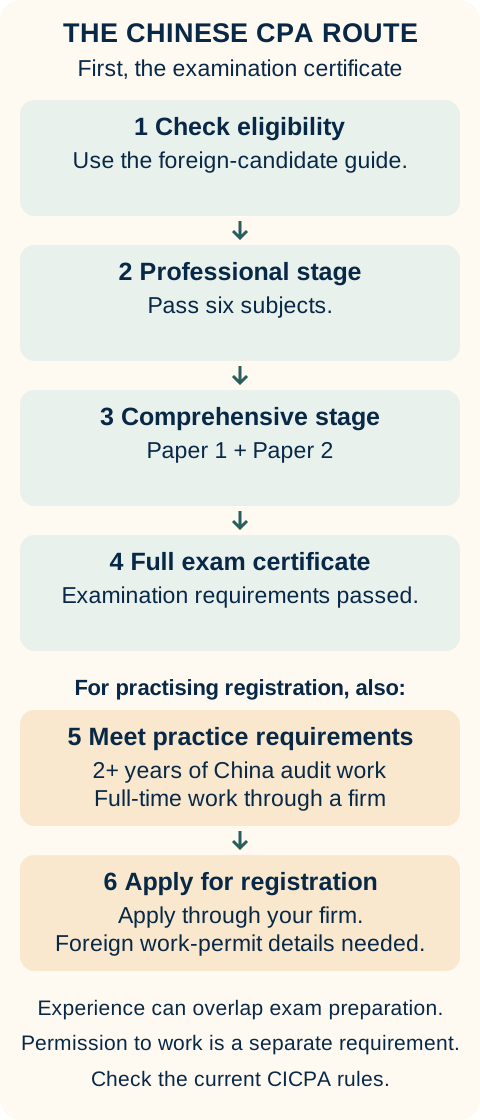
So the real route looks more like this:
Meet the foreign-candidate eligibility requirements
→ Pass the six professional-stage subjects
→ Pass the comprehensive stage
→ Receive the full examination certificate
→ Obtain qualifying audit experience in China
→ Meet the practising and employment requirements
→ Apply for CPA registration through an accounting firm
This is a set of requirements, not a compulsory timeline in which audit experience can begin only after the exams. Yang’s story also shows that employment and examination preparation can overlap.
That is very different from saying:
“Pass the exam and you become a Chinese CPA.”
The qualification also does not automatically give you the right to work in China
Professional qualification and permission to work are separate systems.
A foreign national still needs a lawful employment route.
For the usual employer-sponsored route, China’s foreign-work rules require an actual employer in China and the professional skills or knowledge needed for the job. The employer is part of the work-permit process.
So this sequence is wrong:
I passed the Chinese CPA exam → therefore I can work in China.
A better way to think about it is:
The qualification may make you more valuable to an employer, but you still need to qualify separately for legal employment in China.
That subject is large enough for another Happier China guide.
Is the Chinese CPA actually valuable for a foreigner?
There is no honest one-size-fits-all answer.
If you plan to work only in your home country, rarely use Chinese professionally and have little connection with China-related accounting, audit, tax or corporate work, the amount of study required may be difficult to justify.

The route becomes much more interesting if you are:
- an accountant or finance professional already working with China;
- a foreigner who studied accounting, finance or business in China;
- someone who already works professionally in Chinese;
- a foreign accountant supporting Chinese companies overseas;
- a professional supporting foreign companies operating in China;
- someone building a career in cross-border audit, tax, advisory, compliance or corporate finance.
For these people, the qualification can mean more than passing another accounting examination.
It can demonstrate that you have learned a substantial part of the Chinese accounting, tax and regulatory environment in Chinese.
Yang Hae-sook’s experience is one example of what that combination can look like in practice.
It does not guarantee another candidate the same career.
Who should probably wait?
If your Chinese is still mainly conversational, do not begin by buying an expensive six-subject CPA package.
Start with the official questions.
If one Accounting or Economic Law question requires constant translation, the immediate project is probably professional Chinese, not CPA exam technique.
The same applies if you have no accounting background at all.
In that case, you are trying to learn two difficult things at the same time:
accounting itself
and
accounting in Chinese.
That is possible.
It is not necessarily efficient.
A one-weekend test before you commit
Before planning a year of study, try this:
- Download the current official syllabus.
- Choose the subject closest to your existing background.
- Read several previous questions without using a translation tool first.
- Try the official computer-based practice system.
- Write at least one complete answer in Chinese.
- Watch one or two hours of a reputable Chinese CPA lecture.
- Decide whether your main difficulty is accounting knowledge or professional Chinese.
- Only then compare paid courses.
That experiment may tell you more about your chances than a training company’s sales page.
The bottom line
Yes, a foreign national can take China’s CPA examination.
There is a formal foreign-candidate system, national online registration, designated examination cities and extensive official preparation material.
But legal eligibility is only the beginning.
The harder questions are:
Can you work with professional accounting and legal Chinese under examination conditions?
Does Chinese accounting expertise fit the career you actually want?
And if you want to practise or work in China afterward, can you meet the separate registration and employment requirements?
A Korean candidate has already shown that the route is possible.
Her experience also shows why the qualification is not a shortcut.
It is a serious professional project.
For the right person, that may be exactly why it is valuable.
Useful Chinese
Show this to staff, or play it if your device has a Chinese voice.
Certified Public Accountant / CPA
Chinese Institute of Certified Public Accountants / CICPA
National Unified CPA Examination
Professional-stage examination
Comprehensive-stage examination
Qualification review
Can I register with a foreign passport?
Can I use my degree to register?
Sources & verification
Last checked by Happier China: Oct 15, 2026
The dates below belong to the source publishers. Check the responsible service’s current instructions when making a booking or application.
- 2026 CPA registration guide for foreign nationals and Hong Kong, Macao and Taiwan residents
CICPA
Published: Mar 11, 2026 - 2026 professional and comprehensive examination syllabuses
CICPA
Published: Mar 4, 2026 - CPA practising registration rules
Ministry of Finance
Published: Apr 27, 2022Source note: rules amended Mar 15, 2019 - Working and living in China: official guide for business expatriates
Ministry of Commerce / State Council portal
Source date: 2025 edition - Yang Hae-sook interview — Korean-language original
Ewha Womans University
Published: Sep 10, 2019 - Yang Hae-sook’s Chinese CPA preparation — Korean-language interview
Shanghai Journal
Published: May 27, 2013
More sources (15)
- Free official preparation assistant and previous questions
CICPA
Source date: Publication date not supplied - 2026 official computer-based examination practice announcement
CICPA
Published: Apr 14, 2026 - 2026 examination questions and answers: materials and training
CICPA
Published: Mar 11, 2026 - PRC CPA Law, 2026 text
Ministry of Finance
Published: Aug 10, 2026Source note: amended Jun 26, 2026 - Guangzhou’s directory of 41 qualification examinations open to overseas persons
Guangzhou Human Resources and Social Security Bureau
Published: Jun 29, 2026 - 2026 legal professional qualification examination: official local implementation notice
Changde Justice Bureau, implementing Ministry of Justice announcement No. 6
Published: Jun 10, 2026 - 2026 software professional qualification examination: Shanghai notice
Shanghai Human Resources and Social Security Bureau
Published: Mar 12, 2026 - Foreign graduates of Chinese medical programs: physician examination route
Ministry of Health / Beijing Government policy portal
Published: Sep 3, 2001 - 2026 national tour-guide qualification examination notice
Ministry of Culture and Tourism
Published: Jul 31, 2026 - Teacher qualification examination eligibility FAQ
National Education Examinations Authority
Source date: Publication date not supplied - Questions about the new White House press secretary’s legal credentials
Associated Press via ABC News
Published: Oct 14, 2026 - Ma Yong CPA Accounting series — provider’s Bilibili channel
Zhiliao Classroom / Bilibili
Source date: Publication date not stated in this guide - Zhang Jingfu CPA Accounting foundation series — provider’s Bilibili channel
Dongao Education / Bilibili
Source date: Publication date not stated in this guide - Provider’s guide to Ma Yong’s free introductory CPA resources
Zhiliao Classroom
Published: Apr 2, 2026 - Official CICPA Computer-Based Exam Practice System (2026)
CICPA-designated practice system
Source date: 2026 systemSource note: announced Apr 14, 2026
Comments & practical questions
Keep comments practical and relevant. Off-topic political or religious arguments, explicit content, hate, spam or illegal content may be removed. Comments are reviewed before publication. Comment rules.
Loading comments…