
Guangzhou · Food & dining
Eating in Guangzhou: What to Order, How to Order, and What May Surprise You
A practical first meal in Guangzhou: dim sum to try, tea charges, QR ordering, shared dishes and useful Chinese for restaurants.
Guangzhou is one of those cities where eating well is easy — once you know how things work.
The difficult part for a first-time visitor is often not finding food. Restaurants are everywhere. The difficult part is walking into one, understanding what kind of meal you are about to have, reading the menu, using a Chinese QR ordering system, and knowing what will actually arrive at the table.
That matters because Guangzhou is not just a city with good food. Food is part of how the city lives.
In 2026, Guangzhou even introduced local regulations to protect its traditional morning tea culture — 广州早茶. The official definition is simple: tea served with Cantonese dim sum, combined with the social customs and food traditions that grew around it. 广州市文化广电旅游局
If you only have time for one distinctly Guangzhou meal, start there.
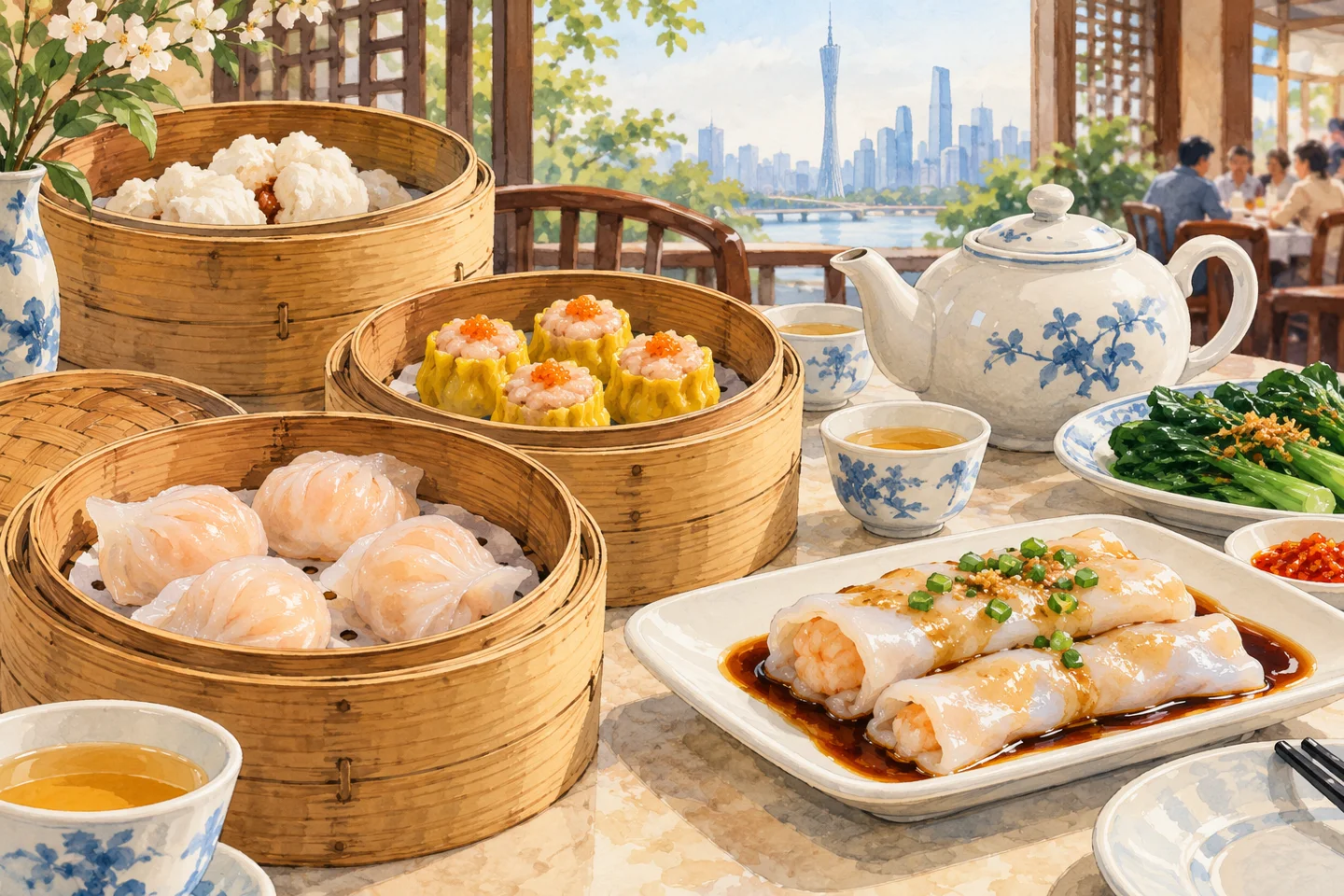
Start with yum cha, not a “must-eat” checklist
You may already know the words dim sum. In Guangzhou, you will also hear yum cha, from the Cantonese expression for “drinking tea.”
But morning tea is not simply breakfast with dumplings.
People meet family, talk business, read the news, catch up with friends and stay at the table for much longer than they would over a quick Western breakfast. Guangzhou’s tourism authorities describe “一盅两件” — one pot of tea and a couple of dim sum dishes — as a classic image of the tradition, not a strict ordering rule. 广州市文化广电旅游局
You can order two dishes. You can also order eight.
Nobody is keeping score.
And despite the English phrase “morning tea,” many restaurants now serve Cantonese dim sum well beyond the early morning.
What should you order the first time?
You do not need an adventurous palate to enjoy Cantonese dim sum.
A useful first table might look like this:
| Chinese | Pinyin | What you are getting |
|---|---|---|
| 虾饺 | xiā jiǎo | Steamed shrimp dumplings |
| 烧卖 / 干蒸烧卖 | shāo mài / gān zhēng shāo mài | Open-topped pork and shrimp dumplings |
| 叉烧包 | chā shāo bāo | Soft steamed buns with barbecue-pork filling |
| 肠粉 | cháng fěn | Soft rice-noodle rolls, often with shrimp, beef or pork |
| 排骨 | pái gǔ | Small steamed pork-rib pieces, often with black bean |
| 凤爪 | fèng zhuǎ | Braised or steamed chicken feet |
| 蛋挞 | dàn tà | Cantonese egg tart |
If chicken feet sound like too much for breakfast, do not order them.
There is no prize for eating the most unfamiliar item on the menu.
Tea may appear before you have ordered food
At a traditional tea restaurant, one of the first questions may be which tea you want.
You may be offered pu’er, black tea, green tea, oolong or chrysanthemum tea. Guangzhou’s current morning-tea rules specifically require restaurants that charge a tea-seat fee — 茶位费 to provide a choice of teas rather than treating the charge as meaningless table rent. 广州市文化广电旅游局
Ask about the per-person tea charge before ordering. Check the displayed amount rather than assuming it is included in the food prices.
If you do not recognize the tea names, 普洱 — pǔ’ěr is an easy, traditional choice with richer food, while 菊花茶 — júhuā chá is lighter and floral.
The menu may be easier than the ordering system
Many larger restaurants have photographs on the menu, which helps.
The real trouble can begin when a waiter points to a QR code and expects you to order on your phone.
A Chinese-only ordering interface can be harder to navigate than the food menu itself.
Do not stand there fighting the mini-program for fifteen minutes.
Show the waiter your screen and say:
我不会用这个点餐。可以帮我吗? Wǒ bú huì yòng zhège diǎncān. Kěyǐ bāng wǒ ma? I don’t know how to use this ordering system. Can you help me?
At many restaurants, staff can still place the order for you, show you a paper menu, or help you select dishes on the phone.
Your phone’s camera translation is also useful, but look at the food picture and Chinese dish name together. Machine translation can turn perfectly ordinary Chinese dishes into some very strange English.
Do not assume every unfamiliar presentation is a hygiene problem
Cantonese restaurants can present meat and seafood differently from what some overseas visitors are used to.
A chopped chicken dish, for example, may arrive with the head or feet included on the platter. A whole steamed fish may arrive looking very much like a whole fish.
You do not have to enjoy it.
But seeing a chicken head on the plate does not by itself mean the kitchen failed to prepare the food properly.
If it makes you uncomfortable, say so when ordering.
不要鸡头,谢谢。 Bú yào jītóu, xièxie. No chicken head, please.
That tiny sentence can make the meal much more enjoyable. If you have a food allergy or dietary restriction, explain it before ordering; a menu photograph cannot confirm every ingredient.
Cantonese food is bigger than dim sum
Morning tea is the easiest introduction, but it is only one part of Guangzhou eating.
You will see roast meats hanging in windows, rice rolls at breakfast shops, clay-pot dishes, soups that have simmered for hours, steamed fish, seafood, wonton noodles, congee and inexpensive rice meals.
One of the pleasures of Guangzhou is that many good meals are ordinary meals.
You do not have to book a famous restaurant every night.
A small neighborhood place full of local customers at lunchtime may give you a much better sense of how the city eats than a restaurant designed mainly for visitors.
How much should you order?
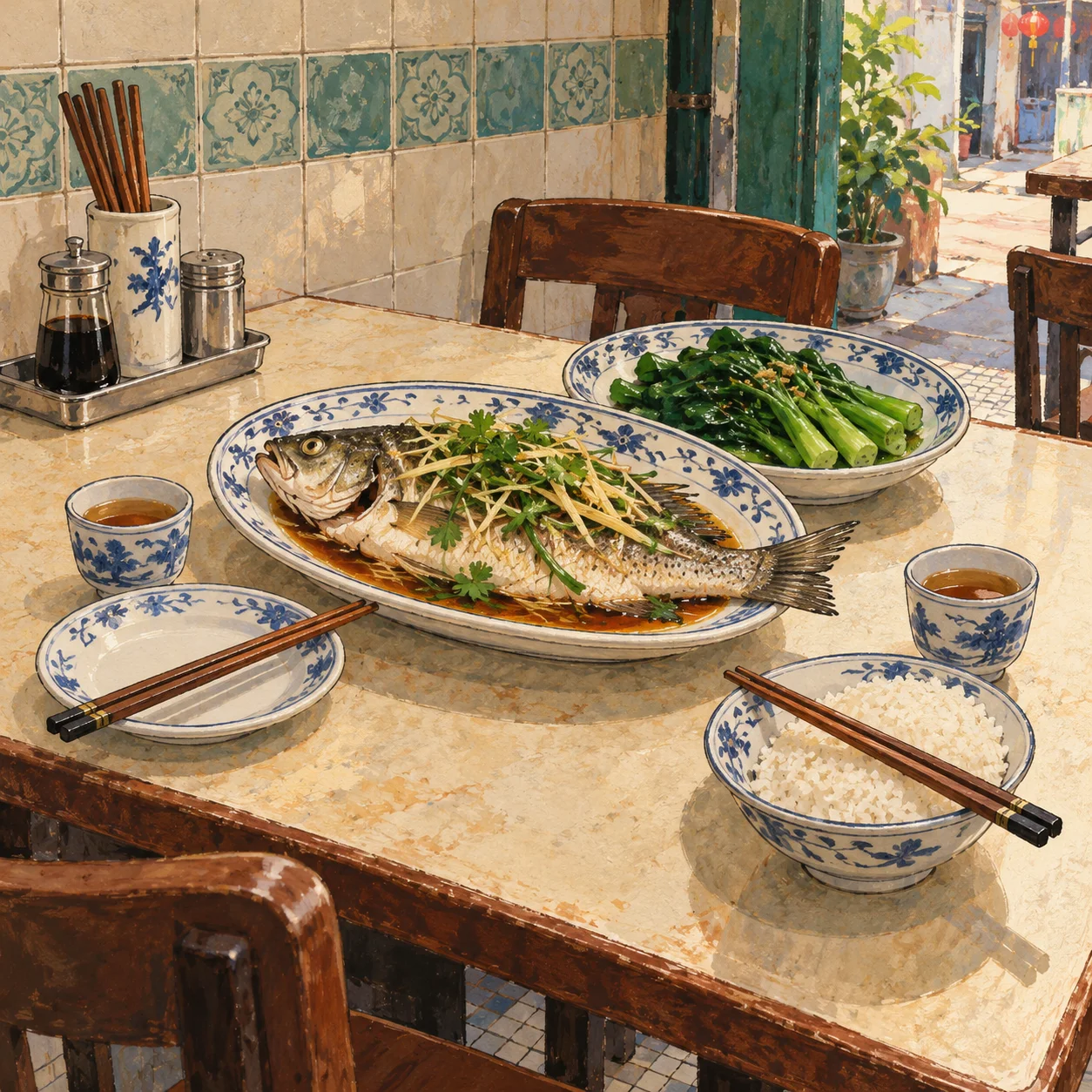
For dim sum, start slowly.
Two people might begin with four or five small dishes and add more if needed. The exact portion size varies widely.
For an ordinary Cantonese dinner, restaurants often expect dishes to be shared.
If you are eating alone, look for smaller rice, noodle, congee or roast-meat restaurants rather than ordering several full-size shared dishes.
Useful question:
这个够几个人吃? Zhège gòu jǐ gè rén chī? How many people is this enough for?
That sentence is worth learning.
You do not need to find “the best restaurant in Guangzhou”
In September 2026, Guangzhou published its first official list of 40 “Traditional Guangzhou Morning Tea Restaurants.” The city also recognized three restaurant groups at headquarters level as part of the program. 广州市文化广电旅游局
The list is useful if you want a more traditional experience.
But it should not turn your meal into homework.
If you find a busy local tea restaurant near your hotel, can understand enough of the menu to order, and see food you want to eat, that is already a good beginning.
Guangzhou food is best understood by eating it more than once.
Useful Chinese
Show this to staff, or play it if your device has a Chinese voice.
Morning tea
Yum cha / go for tea
Dim sum
Do you have an English menu?
Can you help me order?
Is this spicy?
No chicken head, please.
I do not know how to use this ordering system. Can you help me?
How many people is this enough for?
Sources & verification
Last checked by Happier China: Oct 16, 2026
The dates below belong to the source publishers. Check the responsible service’s current instructions when making a booking or application.
- Guangzhou Morning Tea Protection Regulation
Guangzhou Culture, Radio, Television and Tourism Bureau
Published: Apr 2, 2026Effective: May 1, 2026 - Guangzhou tea-house culture and one pot, two pieces
Guangzhou Culture, Radio, Television and Tourism Bureau / Guangzhou Daily
Published: Mar 3, 2023 - First traditional Guangzhou morning-tea restaurant list
Guangzhou Culture, Radio, Television and Tourism Bureau
Published: Sep 22, 2026
Comments & practical questions
Keep comments practical and relevant. Off-topic political or religious arguments, explicit content, hate, spam or illegal content may be removed. Comments are reviewed before publication. Comment rules.
Loading comments…