
Guangzhou first · Mainland China
How to Rent an Apartment in China Without a Local Contact
A Guangzhou-first guide to ordinary rental agents, English-language help, Chinese leases and the conversations that matter after you move in.
Perhaps you came to Guangzhou for a job, to study, or to buy products for your business. After a few visits to the Canton Fair, you may even be considering a longer base in China. But you do not have a Chinese colleague or relative to find a place for you, and you cannot easily discuss a broken air conditioner with a landlord in Chinese.
You can still rent an ordinary apartment. You have several ways to find one, from the neighborhood property agencies used by Chinese residents to companies that specialize in helping international tenants. The trick is to compare the whole arrangement: the apartment, the rent, the paperwork, and who will help when something goes wrong after you move in.
This guide is for people doing much of the work themselves. Guangzhou is our main example, while the national rules also apply in other mainland cities. We will not assume you have a local friend to make calls for you.

I'm new to Guangzhou. What should I do first?
Start by deciding where you need to be, how long you will stay and what you can afford including the first payment, not just the advertised monthly rent.
For a practical first search, try this:
- Pick two or three areas based on an actual commute. Check the route using 高德地图 (Amap) or another map, including the nearest metro station and your normal travel time.
- Browse Beike / 贝壳找房 and Lianjia / 链家 to learn what different apartments look like at your budget. You can use your browser's translation feature to understand Chinese listings.
- Find two or three established local property agencies near the buildings you like. Visit the storefront, or contact an agent through a listing. You can begin without a Chinese personal contact.
- Before arranging a viewing, ask the agent to confirm with the landlord that the home is available, the landlord will rent to a person holding a foreign passport, and the host will handle or cooperate with the initial accommodation registration.
- See the actual property. Request the full charges, the landlord's documents, and the proposed contract before transferring a deposit.
- Ask who will handle repairs, building access, utility questions and translation after the keys have been handed over.
That fourth step matters more than it may seem. In an August 2026 Guangzhou rental discussion, one commenter said a local Anjuke agent eventually found a suitable rental by checking which landlords would accept a foreign tenant. These are personal reports, not proof that every branch can provide the same result, but the account points to a useful habit: let the agent screen the landlord before you spend a day visiting apartments.
Can a foreigner rent in an ordinary Chinese residential community?
Yes, an ordinary residential apartment can be an option. There is no general rule that every foreigner must rent an expensive “expat apartment.” The important checks are whether the property can legally be rented as housing, who is authorized to rent it, the landlord's willingness and the required registration.
You may hear an agent say that a particular cheap apartment or building “cannot rent to foreigners.” Do not assume that describes a nationwide rule. Ask whether the owner has declined, the specific unit has a legal or documentation problem, or someone has misunderstood the registration procedure. If the first owner refuses, ask for alternatives in the same price range.
Check the home itself. Residential buildings, serviced apartments, subdivided rooms and rooms advertised in older urban-village areas are not all the same product. Some may have property-rights, safety, subletting or registration problems. Check the actual address and documents rather than relying on a label such as “ordinary” or “international.”
Are Chinese neighborhood agencies worth trying if I don't speak Chinese?
Often, yes. Try recognized brands such as 链家 (Lianjia), 德佑 (Deyou), 裕丰地产 (Yufeng) or 合富置业 (Hefu / Hopefluent) in the neighborhood you want. Their platforms and branches give you a way to compare normal residential listings rather than looking only at homes marketed internationally.
A large brand does not mean every shop is company-owned, every listing is current or every employee can help a foreign customer. Compare the actual branch, the written fee quote and the agent who will deal with your lease. In 高德地图 (Amap), search, for example, 链家 租房, 德佑 房产中介 or 裕丰地产 together with your preferred district, then check the branch address and opening status before going. You can check housing businesses through Guangzhou's official 阳光租房 (Sunshine Rental) service and the municipal housing authority's published guidance.
Are mainstream agencies guaranteed to have more apartments you can actually rent than specialist agencies? No public, like-for-like inventory comparison was established during this research. They offer a broader general local search route, but individual owners may not accept your proposed lease. Some specialists also search the ordinary market through other local brokers. Count the suitable, currently available apartments that accept your conditions, not the total number on a company's website.
What if I don't have a Chinese phone number yet?
Some Chinese listing services require a mainland phone number or account verification before you can message an advertiser. A Malaysian student who wrote about finding housing in Guangzhou in October 2019 described this as one of the first obstacles encountered while searching from overseas. This is a historical case, so do not assume each app still has the same requirement; it explains why a newcomer may get stuck before viewing even one apartment.
If registration fails, you still have options: inspect public listings in a browser, use a local storefront, contact an agency's official number or inquiry channel, or ask a short-stay hotel to help you identify nearby property shops. You do not have to bypass identity checks or borrow another person's verified account. A Chinese SIM can be useful later, but do not let an unfamiliar app's login screen stop your whole search.
Can I manage viewings with phone translation?
Yes, sometimes surprisingly well. A pair of travelers who looked at apartments near Guangzhou East Railway Station described arranging viewings through WeChat translation even though they and their agent did not share a language. They viewed two properties but did not sign a lease, so their story is evidence of a workable viewing conversation, not proof that every later contract or repair issue is easy.
Use written WeChat messages wherever possible. Ask the agent to send the full Chinese address, monthly rent, viewing time and any important conditions as text. Machine translation is suitable for simple arranging and follow-up; it is not a substitute for understanding a contract clause that could cost you months of rent.
What if the landlord doesn't speak English after I move in?
Ask this before you sign, not during the first emergency. In an academic study of African business migrants in Guangzhou, interviewed landlords specifically worried about handling future problems when they could not communicate with tenants. Some tenants relied on intermediaries to contact landlords. The study was first published online in 2025, but its interviews were conducted in 2015–2016, so it explains a recurring type of problem without measuring how common it is in 2026.
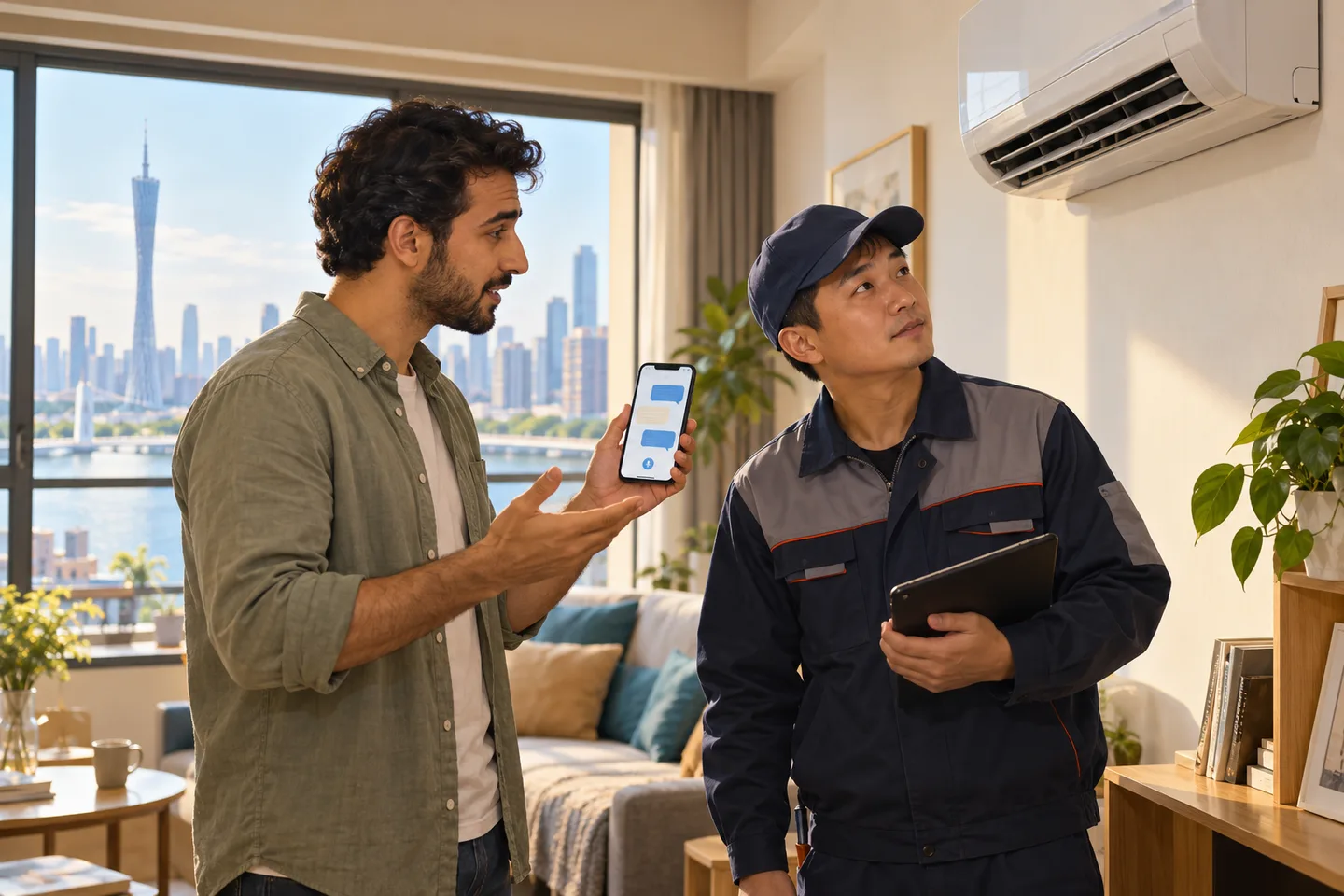
A Japanese-language agency FAQ says that post-move help with landlords can be part of the agency service. This is precisely what you should compare with the lower apparent cost of an ordinary local broker.
Before paying, get plain answers to these questions: Will the agent help after the lease is signed? For how long? Is that included in the fee? If the agent leaves the company, who replaces them? Who actually arranges repairs inside the apartment? Can I send written messages in English?
Also find out what the building's 物业 (property management) office handles. It may help with lifts, access cards, shared facilities, parcels or common-area issues, but it may not be responsible for your privately owned air conditioner, plumbing or other appliances inside the flat. The landlord or rental operator may still need to approve and pay for repairs under the contract.
A sensible arrangement is to keep three contacts saved: the landlord or rental operator, the agency's continuing-service contact, and the building management desk. Ask them to put responsibilities in writing.
Useful WeChat message before signing:
如果入住后有空调、漏水或电器维修问题,应该联系谁?中介签约后还会继续帮忙联系房东吗?服务是否另外收费?请把联系人和联系方式发给我,谢谢。
English: If the air conditioner, plumbing or appliances need repair after I move in, whom should I contact? Will the agency still help communicate with the landlord after signing? Is there an extra fee? Please send the contact details.
Useful message when something breaks:
你好,房间的空调坏了,从今天上午开始不能制冷。我已拍了视频。请问谁负责安排维修,大概什么时候可以上门?谢谢。
English: The air conditioner has stopped cooling since this morning. I have a video. Who will arrange repairs, and approximately when can someone come? Thank you.
For urgent safety risks such as a suspected gas leak, do not wait for translated messages or keep using the appliance. Leave the unsafe area and seek appropriate immediate local help.
Would an international or Japanese-speaking agency make life easier?
It might. Specialist agencies can arrange bilingual viewings, explain Chinese paperwork, negotiate with a landlord and sometimes help after move-in. People who value their time, families settling into Guangzhou, and small-business owners without Chinese administrative staff may find that worthwhile—not just multinational executives.
Some concrete examples to compare, not endorsements:
- Starts Guangzhou / 世达志 describes its Japanese-language rental search, landlord negotiation, contract and move-in support, including assistance with registration. Its detailed workflow page is dated 2017; confirm that each service is still included today.
- 友和生活 (Yuwa Life), which serves Japanese-speaking residents, says its after-service is included in the brokerage fee. Its Feb 2026 Guangzhou housing Q&A distinguishes comparatively lower-priced private-landlord apartments, where management is generally in Chinese, from staffed serviced apartments with faster support and potentially English-speaking staff.
- Able Network Guangzhou lists Japanese-language contract explanations, utility setup, repair coordination, renewal and move-out assistance. Its published indicative brokerage fee is one month of rent; it also lists possible renewal fees and cautions that charges and service availability vary by property. Ask for the exact written quote. Its publicly listed ground-floor office is K06, Level 1, CITIC Plaza, 233 Tianhe North Road, Tianhe District (广州市天河区天河北路233号中信广场1楼K06号铺); telephone 020-8709-6687. The site lists weekday hours of 09:00–18:00 and closure on weekends and Chinese public holidays. Call to confirm the office and service hours before visiting; this is a Japanese-language service, not a promise of English support.
- ChinaHomeRent Guangzhou advertises English-language landlord communication and rental help. Its publicly posted fee conditions are discussed below.
- SinoGo advertises bilingual viewings and local-agent cooperation, and states that it charges no tenant fee for its house-hunting service. This is a provider claim, not an independently verified transaction or a guarantee that its rents are the lowest.
These options are not limited to luxury apartments, but you should check the actual homes they will show you. A broker with a language service can find a property through the same local owners and agencies as another firm. The key is what is included, what you pay and what will happen afterward.
Does a specialist agency always cost more than a Chinese agency?
Not necessarily. Some advertised fees overlap with the ordinary local market, while one specialist says it charges the tenant nothing. More service can be valuable, but available published prices do not establish that every specialist costs more—or that any provider is cheapest for a comparable home.
Here are examples of published descriptions, not binding quotes for the same flat:
| Source or route | What it publicly says about fees | What still needs checking |
|---|---|---|
| Guangzhou Association of International Exchange of Personnel, rental guide | An agency fee of about one month's rent in total, commonly split between landlord and tenant by negotiation; two months' rent as a deposit is described as common | The page is older; the split depends on the actual company and contract |
| ChinaHomeRent, foreign-tenant service | 0.5–1 month's rent as an initial tenant service fee. Its Guangzhou homepage also advertises a possible 0.25–0.5 month's rent annual support fee for renewals from year two | The two provider pages use different qualifying language. Ask for one complete written, lease-specific quote before agreeing |
| Able Network Guangzhou, Japanese-language brokerage | Publishes an indicative one month of rent as its brokerage fee. Its page also lists renewal fees, sometimes one month of rent or half a month for a one-year contract, subject to the actual case | Ask whether the advertised service package includes translation, repairs and move-out coordination, and obtain a property-specific quote |
| SinoGo, English-language house hunting | Says there is no fee charged to the tenant for viewings/search | Ask who pays the agency, whether quoted rent includes any third-party charge and whether after-move support is included |
| Wellcee, direct-rental platform | States it does not charge agency or viewing fees on its direct-listing platform | Check whether a particular advertiser is truly an owner or authorized tenant and what deposit, rent and other charges apply |
A useful comparison is the cash needed to move into the same RMB 4,000/month apartment. If the agreed terms are two months' deposit and one month's rent upfront, that is RMB 12,000 before any agency fee. An additional half-month agency fee makes the initial total RMB 14,000; a full-month fee makes it RMB 16,000. Those are simple examples, not quoted deals or a legal fee schedule. If one provider charges nothing upfront but proposes a higher monthly rent, compare the cost over the whole lease, not just move-in day.
Ask every agency for the same information: monthly rent, deposit, rent due before move-in, reservation payment and whether it counts toward rent, agency fee, management or ongoing support fee, utility rates, taxes or invoice costs if applicable, renewal costs, move-out and early-exit terms. Ask which person or company receives each amount.
Remember that a brokerage agency is not the same as a company that rents and operates homes in its own name. Under China's 2025 housing-rental regulations, a housing brokerage agency must disclose its priced services and must not collect or pay rent or deposits on behalf of landlord and tenant. Establish who is your contractual landlord or operator and who should receive each payment. Read the national regulation.
Can I browse English websites instead of talking to Chinese agents?
You can start there. Wellcee's Guangzhou listings have an English interface and can be useful for rooms, whole flats, housemates and shorter stays. Wellcee describes itself as an agent-free direct-rental platform. Confirm the real landlord, any sublet permission and every payment yourself; a listing platform does not replace those checks.
Mainstream Chinese sites such as Beike, Lianjia, 58.com and, where available, Ziroom may show different rental types. Some listings lead to a broker, some to a managed rental operator, and some to an advertiser claiming to be an individual landlord. Ask who actually signs the lease. You may still need Chinese-language messaging or identity verification to use an app.
For a value-focused search, use more than one route. A narrower specialist shortlist is not automatically worse if those homes already meet your budget and paperwork needs. A massive general listing count is not the same as the number of homes you can actually rent.
What if the agent suddenly raises the price because I am foreign?
First, ask for the new price and the reason in writing. Separate the monthly rent from a disclosed service charge, building fee or any other proposed cost. Compare other homes in the same neighborhood and decline a deal that does not make sense.
An August 2026 Guangzhou tenant's post describes an agent reporting an extra RMB 1,000/month after the landlord learned the tenants were foreign. The post does not independently establish the landlord's actual reason, the wider market or a standard “foreigner fee.” It is a reason to request an itemized explanation—not a reason to assume that all landlords or all specialist agencies charge foreign tenants more.
A landlord's difficulty communicating may be genuine; discrimination and unreasonable pricing are also real concerns in some experiences. Do not automatically attribute every refusal to either factor. A good agent should help you get a clear answer and show alternatives without pressuring you.
What should I send an agent before a viewing?
Save this message in your phone and fill in the blanks:
你好,我持外国护照,想在广州租一套住房。预算每月____元,计划从____开始住____个月。我可以通过微信文字和翻译软件沟通。请先与房东确认是否愿意出租给外国租客,并能否配合依法办理外国人住宿登记。请发这套房现在的真实视频、准确地址、月租、押金、中介费、物业费和其他费用。确认后我再预约看房,谢谢。
English: I have a foreign passport and want to rent in Guangzhou. My budget is RMB ___ per month, beginning ___ for ___ months. I can communicate by written WeChat messages and translation. Before arranging a viewing, please confirm the landlord accepts a foreign tenant and will cooperate with lawful accommodation registration. Please send a current video, address and breakdown of all costs.
A recent video can help identify unsuitable places before you travel. It is not enough to prove that the home exists, is currently available, is legally rented or looks the same today. View the actual unit and match its address to the contract. If the agent shows you a different unit or says the advertised one is suddenly unavailable, ask for the new listing and full price instead of signing under pressure.
How do I avoid losing money on an apartment I haven't checked?
Before making a reservation payment, check the ownership certificate or other proof of the right to rent, the landlord's identity and any agent's written authority. Ask to see the actual home and ask for the draft lease. Do not pay merely because someone says another person will take the apartment in ten minutes.
Inspect practical details, including water pressure, hot water, air conditioning, drains, smell, leaks, noise, locks, the electricity meter, broadband availability and building access. Guangzhou's housing bureau advice from March 2026 specifically warns renters to verify ownership/authorization, check for safety and quality problems and understand deposits and utility charges.
Keep receipts and a written handover inventory (房屋交接单). Photograph existing wear, furniture, appliances and meter readings when you move in, and do the same before leaving. Record which defects the owner will repair before moving day.
If the landlord, operator or agency asks for money, establish who is legally receiving it and why. Under the 2025 national regulation, brokerage businesses are prohibited from collecting rent and deposits for the parties; actual housing operators have different contractual arrangements. A request to send everything to an agent's personal account deserves particular caution.
My rental contract is all in Chinese. What must I understand?
Guangzhou has a useful official reference: its 2026 model residential lease, SF-2026-0601, published on Jan 28, 2026. Open the Guangzhou Housing Bureau's page and downloadable model contract.

A mainstream broker may offer a standard-looking Chinese agreement. Do not assume it is identical to the government's model. Ask for the complete actual lease, including every appendix, inventory and handwritten change. Translate the contract you will sign—not just the sample—section by section. Use this short checklist:
| On the Chinese document | What to check before signing |
|---|---|
| 出租人 / 承租人 | Correct legal names of landlord and tenant; agent authorization if applicable |
| 房屋坐落 / 房屋用途 | Actual building, flat number and permission to use it as housing |
| 租赁期限 / 续租 | Exact start/end dates, notice and renewal terms |
| 租金 / 支付方式 | Rent amount, frequency, due dates and correct receiving account |
| 押金 / 押金退还 / 扣除 | Deposit amount, return timing and deductions |
| 中介服务费 / 其他费用 | Broker charges, continuing-service charges and who pays them |
| 物业费 / 水电燃气费 | Building fees and residential or other applicable meter tariffs |
| 维修责任 | Who repairs appliances, plumbing, leaks and air conditioning |
| 提前退租 / 违约责任 | Consequences if you leave early or the owner ends the tenancy |
| 转租 / 授权委托 | Whether a subletting or agent arrangement is legally authorized |
| 房屋租赁登记备案 | Who files the lease and provides the record |
| 住宿登记 / 房屋交接单 | Host's registration cooperation, keys, inventory and move-in condition |
The city revised its model in 2026 to address disclosure of changes to a building's main and load-bearing structures. Ask about those disclosures if the landlord has changed the home's layout.
For many leases, translation software is a practical first pass. But if a clause is unclear and could cost you a large deposit or several months' rent, ask a professional translator or a qualified lawyer to review it. Translation, stamped translation, legal review and notarization are different services. A routine residential lease does not automatically need notarization.
Do not upload a full unredacted passport, another person's identity card or bank-account data to an unknown translation website simply to understand the lease. Redact unnecessary personal information where practicable, without making it impossible to check the names and documents privately with the parties.
How much deposit should I expect?
There is no single deposit amount for every privately rented apartment. In a general Guangzhou rental guide, two months' rent as a deposit and one month's rent paid at signing are described as common; this is a market description, not a legally required formula. Your contract must spell out the deposit, return deadline and deductions.
The Guangzhou Housing Bureau's March 2026 notice makes a separate point about homes sublet by a housing-leasing company: rent should generally be collected for no more than three months at a time, the deposit should generally not exceed one month's rent, and funds should use the published supervision account. Do not apply this company-subletting principle to every private-landlord lease without checking the transaction type.
Before paying any “reservation money” (定金 / 订金 / 手付金), ask whether it counts toward the first rent, who receives it, and exactly what happens if either side cancels. The Chinese characters and the wording of the signed agreement can make a real difference; do not assume every payment called a deposit is refundable.
How do I register my address after I move in?
If you are a foreigner staying in a non-hotel residence, Chinese law requires accommodation registration within 24 hours of arrival at that residence. A hotel handles its own hotel-guest reporting, but a privately rented home needs the non-hotel process.
Since Sep 21, 2026, this registration can be completed online nationwide through the National Immigration Administration's website, the 移民局12367 (NIA 12367) mobile app, or its WeChat and Alipay mini-programs. A police-station route remains available, and the online process has the same legal effect. Official notice in English.
There is an important detail for the first registration of a home rented from someone else: the NIA's official user guide says the host handles that initial registration. A foreign tenant may self-register in certain later situations, and the repeat process can require a code sent to the host. So before paying, confirm that the host will complete the first registration promptly, or clarify the applicable in-person procedure with the local police. If the online step fails, use the local police-station route; the NIA helpline is 12367.
For the complete steps and fallback, see our non-hotel accommodation registration guide.
The housing-lease filing (房屋租赁登记备案) is a different requirement. China's 2025 housing-rental regulation says the landlord should file the lease, allows the tenant to do so if the landlord does not, and assigns the filing task to the brokerage agency when landlord and tenant sign through one. Guangzhou's March 2026 advice asks tenants to cooperate with filing within 30 days of signing. Before signing, ask the agency or landlord who will file and how you will obtain confirmation. Registration information can be shared among authorities under the national regulations; avoid anyone who promises that ignoring one requirement is safe because different departments allegedly never exchange data. National housing-rental regulation.
I'm staying only one to three months. Should I sign a normal annual lease?
Not unless the landlord clearly agrees in writing to your intended short stay and the costs of leaving. Many owners prefer a one-year contract, so a cheap annual rent can become expensive if you lose a substantial deposit for leaving early.
Compare a hotel, a legally operated serviced apartment, a managed short-term unit and a truly short residential tenancy. Ask which type you are booking: not everything advertised as a “serviced apartment” handles guest registration as a hotel. Check cleaning, internet, utilities, minimum stay, cancellation, tax invoice if needed and registration responsibility. The right answer may be a higher-priced monthly room that avoids a long contract and unknown repair obligations.
I'm here for business. What if I want to open a representative office?
You can rent a personal apartment while planning a sourcing operation. But your home and a registered representative-office address are not automatically the same thing. The office's permitted activities, registered premises, documents and lawful work arrangements are separate questions. Do not sign an ordinary residential lease assuming it automatically qualifies as your business registration address. Large companies may ask HR or a relocation service to handle housing; a small independent buyer can still use an ordinary local agent.
Which route should I choose?
If you want a broad local search and are willing to translate messages, start with mainstream Chinese platforms and reputable neighborhood agencies. Ask the agent to screen the landlord, compare more than one home, and set up written post-move contacts.
If you want an English interface and direct contact, try Wellcee, but verify the advertiser's authority and the lease yourself.
If you would rather pay for coordination, or need someone who can speak to the landlord throughout your stay, compare specialist agencies and managed accommodation. Request written fees and after-service terms from at least two providers; a specialist may cost more, the same, or less in up-front fees, and its rent may differ.
Whichever route you use, remember the four decisions that matter: Is this the right apartment? Is the full price fair? Can I understand and enforce the contract? Who helps me complete registration and solve problems after move-in?
This independent guide provides general practical information, not individual legal advice or an endorsement of any agency or landlord. Rules, prices and service availability may change; confirm consequential details with the official authority or provider involved.
Comments & practical questions
↑ Back to topKeep comments practical and relevant. Off-topic political or religious arguments, explicit content, hate, spam or illegal content may be removed. Ordinary comments appear immediately. Some comments are held for review. Comment rules. Times shown in China Standard Time (UTC+8).
Loading comments…