
Guangzhou · Everyday meals
Affordable Meals in Guangzhou: Breakfast, Convenience Stores and Supermarket Food
Find affordable meals in Guangzhou through breakfast shops, convenience stores and supermarkets, with useful Chinese and realistic discount advice.
A hotel room without breakfast is not a problem in Guangzhou.
In fact, if you are willing to eat the way ordinary people around you eat, breakfast can be one of the cheapest and easiest meals of the day.
You do not need a hotel buffet, and you do not need to find a Western café every morning.
A local breakfast shop, convenience store or supermarket can often solve the problem in a few minutes.
Look downstairs first
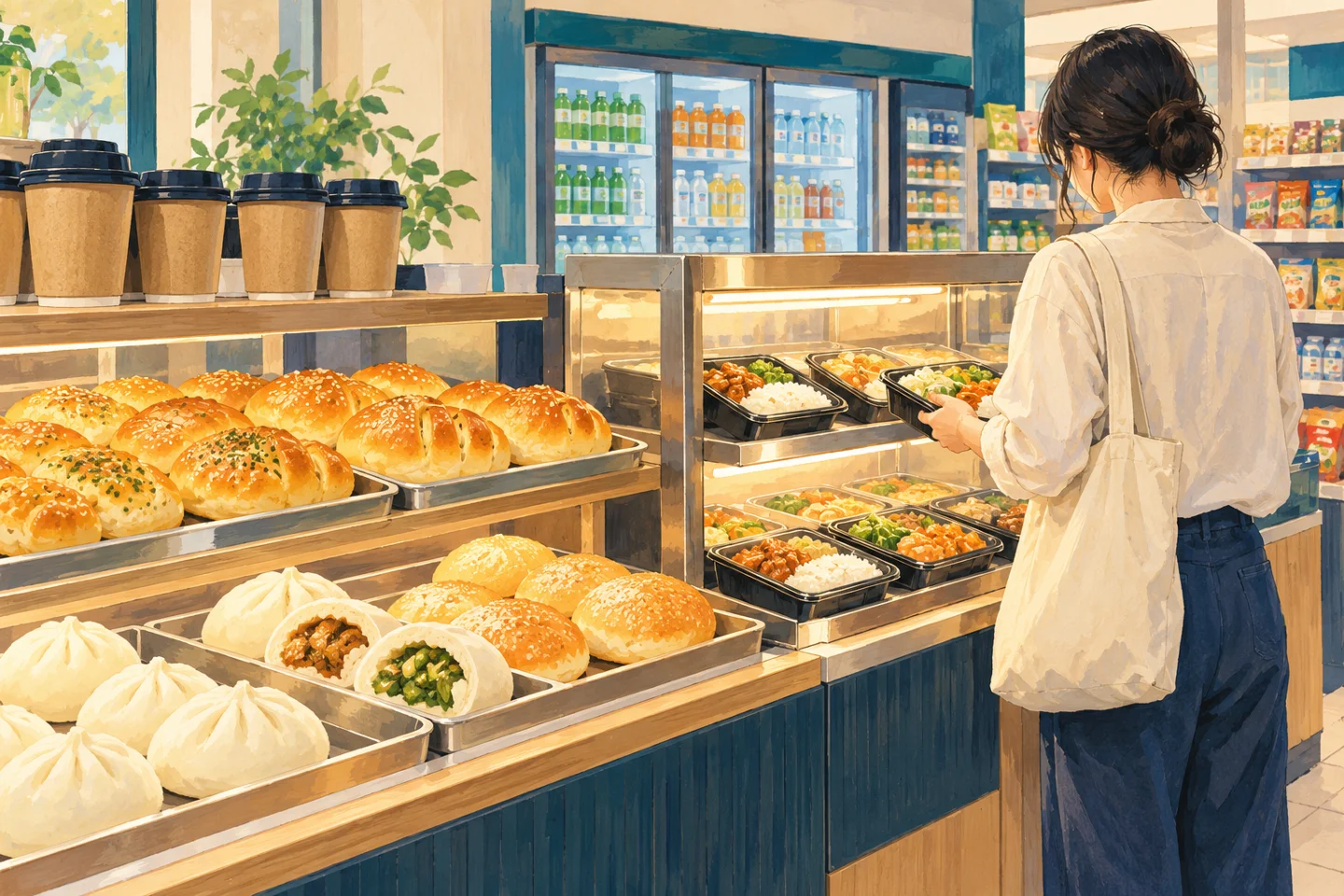
In residential and commercial parts of Guangzhou, the easiest breakfast is often close to your hotel.
You may see steam coming from bamboo baskets, trays of buns behind glass, a rice-roll shop working at full speed, or people carrying cups of soy milk to work.
Some common options are baozi — 包子, steamed buns with meat or vegetable filling; mantou — 馒头, plain steamed bread; doujiang — 豆浆, soy milk; zhou — 粥, rice congee; and changfen — 肠粉, fresh rice rolls with sauce and a choice of filling.
Rice rolls are particularly worth trying in Guangzhou.
They are soft, inexpensive and usually cooked to order.
If you are not sure what is inside a bun, ask before buying.
这个是什么馅? Zhège shì shénme xiàn? What filling is this?
If you want pork:
我要猪肉的。 Wǒ yào zhūròu de. I’d like the pork one.
Is an ordinary street-side breakfast shop safe?
Do not assume that “small” means “illegal” or “unsafe.”
China has food-business licensing and filing systems covering restaurants and small food operators, and Guangzhou publishes food-business licensing and filing information through its market-supervision system. Guangzhou Market Regulation Administration
But a licence does not mean every shop is equally clean.
Use the same judgment you would use anywhere else.
Freshly cooked, thoroughly hot food is a more useful thing to look for than a crowd alone. Popularity does not guarantee food safety; avoid cooked food that has been left lukewarm.
Look at the counter, cooking area and utensils.
If something smells wrong or the shop makes you uncomfortable, walk another fifty metres. In Guangzhou, you will probably find another breakfast option.
A convenience store can be breakfast
This is easy to overlook if you come from a country where convenience-store food mostly means chips and soft drinks.
In Guangdong, a convenience store can function almost like a small takeaway kitchen.
7-Eleven South China says that by March 2026 it had more than 340 “7-Eleven Small Canteen” outlets in Guangdong, offering fresh food and made-to-order baked items. 7-Eleven
The exact range varies by store, but you may find steamed buns, sandwiches, sausages, rice dishes, hot snacks, yogurt, milk, coffee and other ready-to-eat food.
For a visitor who cannot read much Chinese, a convenience store has another advantage:
You can point.
That is sometimes easier than navigating a restaurant mini-program.
Supermarkets are not only for groceries
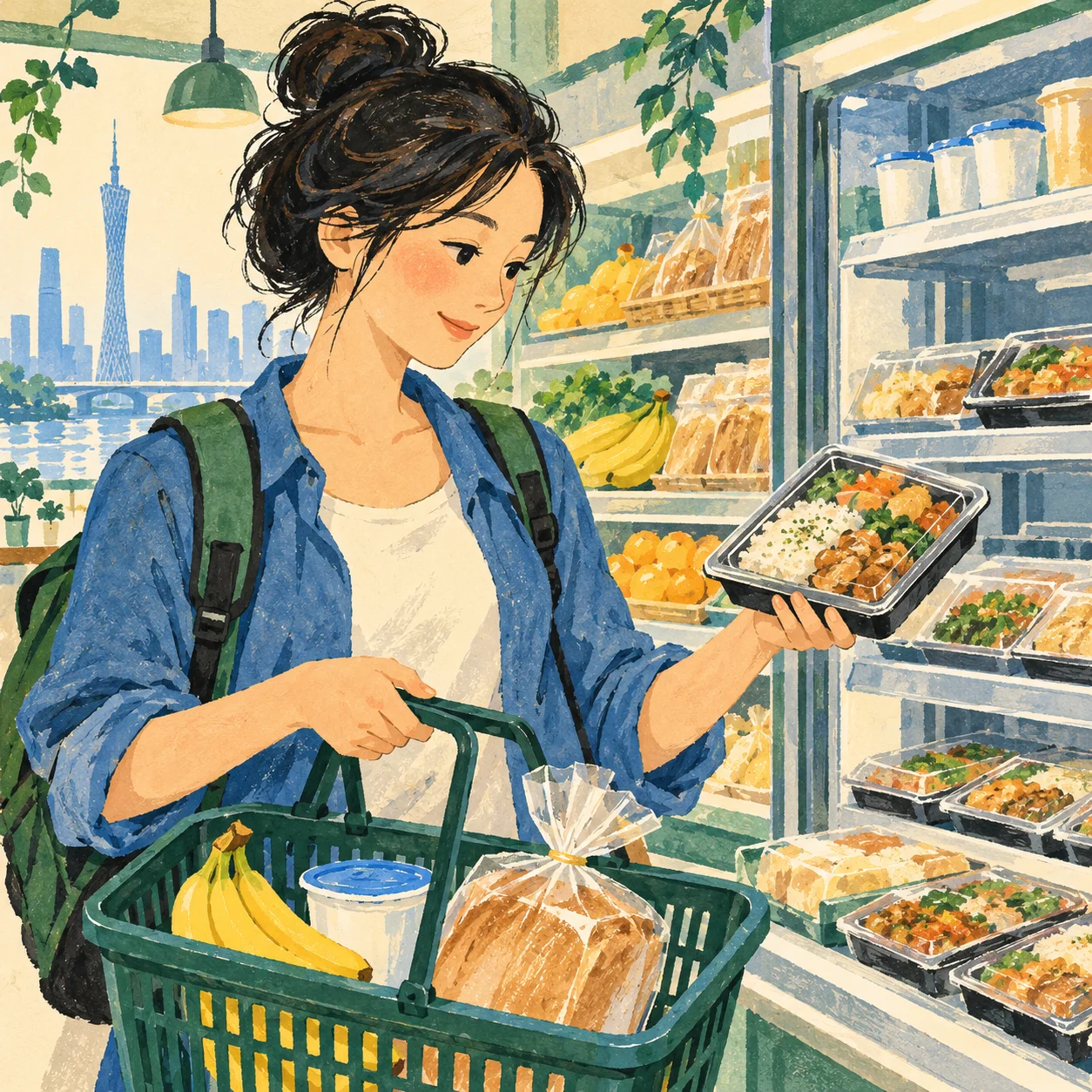
A large supermarket can also be a cheap-food stop.
Modern Chinese supermarkets increasingly sell food meant to be eaten immediately: bakery products, fruit, cooked dishes, rice meals and grab-and-go items.
Walmart China’s September 2025 description of its Shenzhen community stores, for example, lists bakery products, cooked food and quick meals alongside groceries. That illustrates the format; it does not establish what every Guangzhou branch stocks. 沃尔玛
That makes a supermarket useful if you need:
breakfast for tomorrow morning, something inexpensive to take back to the hotel, fruit and yogurt, or a simple dinner when you are too tired to sit in a restaurant.
You can often see exactly what you are buying before you pay.
The late-evening discount trick
This is one of those small pieces of local knowledge that can save money.
You may find discount stickers on same-day bakery products, prepared food or fresh items later in the evening. Check the actual shelf label, use-by time and storage instructions; this is an opportunity to look for, not a guaranteed offer.
The timing is not universal.
There is no reliable rule that says “all supermarkets discount food at 8 p.m.”
So use the tip this way:
If you are in a supermarket in the evening, look at the prepared-food section and check for discount stickers.
Do not plan your dinner around a fixed markdown time.
If there is no discount, there is no discount.
You do not need to eat restaurant food three times a day
A visitor on a short holiday may enjoy doing that.
Someone staying in Guangzhou for two weeks for the Canton Fair may feel very differently by day five.
There is nothing wrong with having dim sum in the morning, a supermarket fruit-and-yogurt lunch and a simple convenience-store meal at night.
The city has food at almost every price point.
Knowing the ordinary options gives you more freedom.
It also means you do not have to make every meal into a travel decision.
A simple low-cost day
For breakfast, buy two buns and soy milk from a local shop.
For lunch, have rice rolls, noodles or a simple rice meal.
Buy fruit and bottled water from a supermarket on the way back to the hotel.
If you are tired in the evening, check the supermarket or convenience store before opening a delivery app.
That may not be the meal you post on Instagram.
It may be the meal that makes a two-week business trip much easier.
Useful Chinese
Show this to staff, or play it if your device has a Chinese voice.
Breakfast
Steamed filled bun
Soy milk
Rice-noodle rolls
Congee
What filling is this?
Can you heat this up?
Is this discounted?
Sources & verification
Last checked by Happier China: Oct 16, 2026
The dates below belong to the source publishers. Check the responsible service’s current instructions when making a booking or application.
- 7-Eleven South China Small Canteen program
7-Eleven South China
Publication date not provided - Community stores and everyday food formats
Walmart China
Published: Sep 13, 2025 - Food-business licensing and filing announcements
Guangzhou Market Regulation Administration
Publication date not provided
Comments & practical questions
Keep comments practical and relevant. Off-topic political or religious arguments, explicit content, hate, spam or illegal content may be removed. Comments are reviewed before publication. Comment rules.
Loading comments…