
Mainland China; comparisons are orientation only and named exceptions remain jurisdiction-specific.
Driving in Mainland China: Traffic Rules That May Surprise You
Driving in mainland China? Learn the key differences in red-light turns, road position, junctions, signs and crash response before you rent a car.
If you already drive in Europe, the United States, Canada, Australia, New Zealand, Japan, South Korea or Southeast Asia, you may feel at home behind the wheel in China. Some basic rules are familiar. Others can catch you out, especially at busy city junctions.
This guide focuses on the differences that matter when you rent a car and drive in mainland China. It is not a full driving manual. Before setting off, read the rental company's instructions, follow the signs and road markings in front of you, and remember that you need a valid Chinese driving licence or temporary driving permit. A foreign licence or an International Driving Permit alone does not give you permission to drive in mainland China. Beijing traffic police confirm that a foreign licence cannot be used directly. See our car-rental and temporary-permit guide for the document preparation.
Happier China has put the main differences into practical examples so you can check the rules before you meet them on the road.
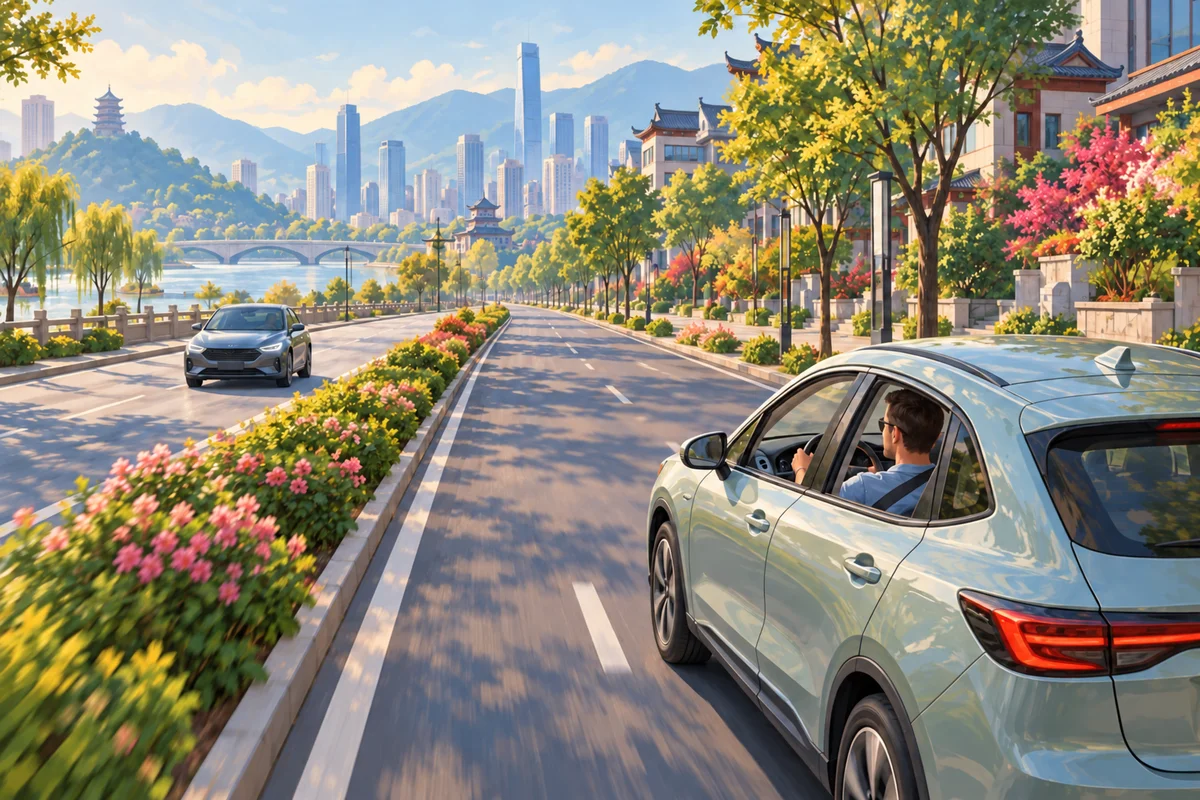
The quick comparison
| Driving situation | Mainland China | What may be different elsewhere |
|---|---|---|
| Which side of the road? | Drive on the right; the steering wheel is usually on the left. | UK, Japan, Australia, New Zealand, Singapore and Malaysia drive on the left. Cyprus, Ireland and Malta also drive on the left within the EU. |
| Turning right at a red light | A normal round red light generally allows a right turn if you do not obstruct traffic or pedestrians with the right of way. A red right-turn arrow prohibits the turn. Signs, road markings and police directions can also prohibit it. | California and Québec are examples of jurisdictions allowing a right turn on red after stopping and yielding, with restrictions. Montréal Island prohibits it. Check local rules. In the UK, Japan, Australia, New Zealand and Singapore, do not assume you may turn through a red light. |
| Pedestrians | Give way when required by signals, crossings and traffic rules. Watch for pedestrians crossing as you turn. | Legal details differ, but turning across a crossing is a danger everywhere. Slow down and check both sides. |
| Motorcycles and e-bikes | Expect electric bicycles, scooters and other small vehicles around junctions and beside cars. Check blind spots before turning or changing lanes. | The mix and volume of road users may be different from what you are used to. |
| Speed limits | Follow the posted limit for that road and lane. Do not guess from the road's appearance. | Default limits vary by country and, in the US, Canada and Australia, by state, province or territory. |
| Signs and navigation | Some direction signs use Chinese place names and pinyin. Navigation does not override signs or signals. | Shapes may be familiar, but wording, road layouts and local rules can differ. |
| Crashes | Stop safely, protect people first, and contact police and the rental company as needed. | Reporting rules and emergency numbers differ. In mainland China, call 110 for police and 120 for an ambulance. |
This table is a quick orientation, not a substitute for local rules.
1. First, remember: mainland China drives on the right
Under Article 35 of the Road Traffic Safety Law, motor vehicles keep to the right side of the road. Most cars have the steering wheel on the left.
If you normally drive in the UK, Japan, Australia, New Zealand, Singapore or Malaysia, this is one of the biggest changes. Your instinct at a junction may tell you to look in the wrong direction first.
Before moving off:
- Adjust your seat, mirrors and navigation before driving.
- At every turn, deliberately check the direction from which traffic may approach.
- Keep to the marked lane. Do not cut across lanes at the last moment because your navigation says to turn.
- At a petrol station or car park exit, pause and check which side of the road you must join.
2. Red lights: understand this before you drive
Can you turn right at a normal red light in mainland China?
Generally, yes — if it is a normal round red signal, the turn is not prohibited by a sign or marking, and you do not obstruct vehicles or pedestrians that have the right of way. Article 38 of the Regulations for the Implementation of the Road Traffic Safety Law says a vehicle turning right on red may proceed if it does not obstruct vehicles or pedestrians who have been given the right of way.
But “generally allowed” does not mean “turn without stopping or looking.” Slow down, check the junction and crossing, and give way. If traffic or pedestrians are moving through the space you need, wait.
When must you NOT turn right?
- A red right-turn arrow is lit: do not turn right. A directional right-turn arrow applies to that turn. Article 41 identifies directional arrows; Article 38 supplies the red-signal prohibition. An official Guangzhou administrative review decision confirms that turning through a red right-turn arrow is a violation. Article 40 concerns lane-control signals and should not be confused with Article 41.
- A sign or road marking prohibits right turns: obey it, even if other drivers turn.
- A police officer directs traffic differently: follow the officer's directions.
- The turn would obstruct or endanger people or traffic with the right of way: wait until it is safe and lawful.
- A lane signal, temporary traffic control or other applicable signal restricts your movement: follow that control.
Look carefully to see whether the red light is a normal circular signal or a red arrow for a particular direction.
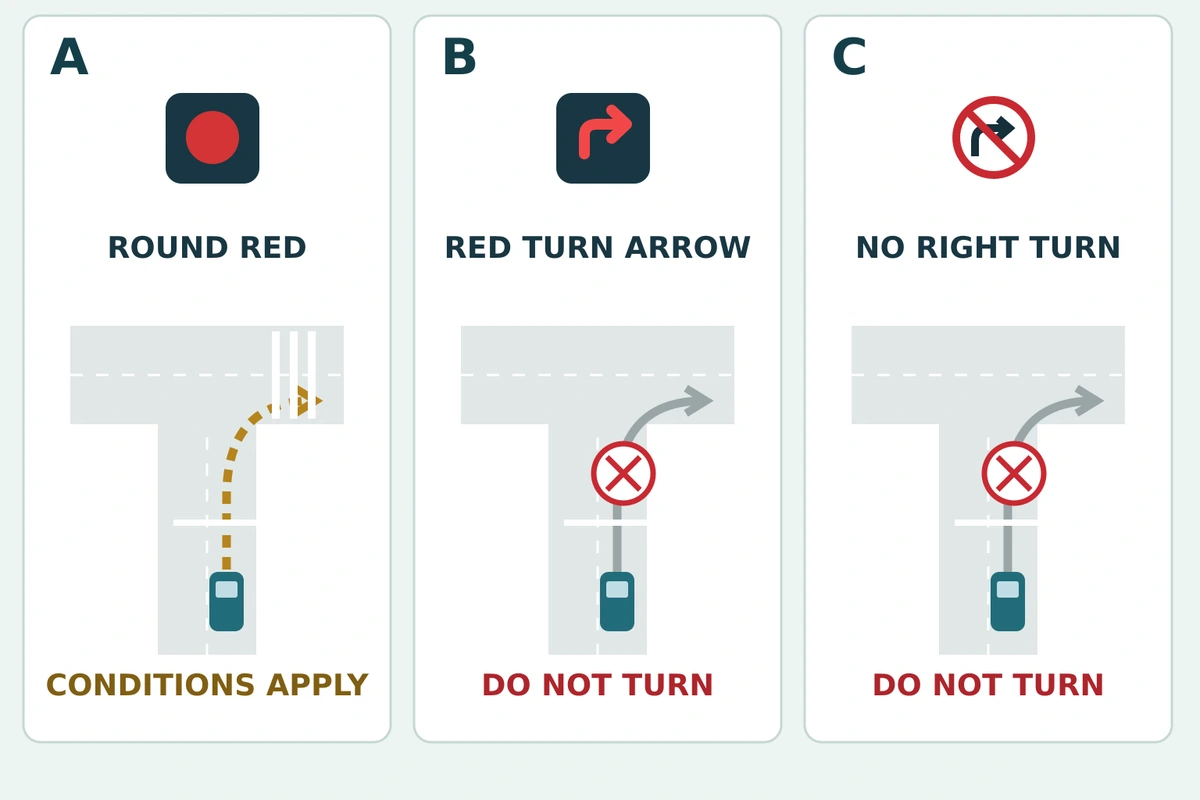
| Case | What the driver must do |
|---|---|
| A — Normal round red | A right turn is generally allowed only if no sign, marking, directional signal, lane control or police direction prohibits it, and you do not obstruct vehicles or pedestrians with the right of way. Slow down, check and yield; wait if the way is not clear. |
| B — Red right-turn arrow | Do not turn right while that arrow is red. |
| C — No-right-turn sign or police restriction | Do not make the prohibited right turn. Follow a traffic officer’s directions if the officer is controlling traffic. |
How does this compare with the United States and Canada?
Rules depend on the jurisdiction. For a specific US example, California's official handbook allows a right turn on a circular red after stopping and yielding, unless a sign prohibits it; a red arrow prohibits the turn. In Canada, Québec's current official guidance permits right turns on red after stopping and yielding, except on Montréal Island and where signs prohibit them. Check the state, province or city where you will drive.
The takeaway is not that China is simply “more permissive” or “stricter.” The legal test is different. In mainland China, a normal round red light generally permits a right turn subject to right-of-way and any local restriction. A red right-turn arrow means you must not turn.
What about a green light?
A green light does not give a turning driver an unconditional right to move first. Under China's implementation regulations, a turning vehicle must not obstruct vehicles or pedestrians who have been given the right of way. Look for people crossing the road you are entering, including people on bicycles and electric bicycles.
3. Junctions: watch the road, not just the navigation
Busy Chinese city junctions can have several lanes, separate turn lanes, non-motor vehicle lanes and crossing pedestrians. The layout may change from one junction to the next.
Before reaching a junction:
- Read the lane arrows painted on the road.
- Check overhead and roadside signs early.
- Move into the correct lane while there is still time.
- Follow the signal for your lane and direction.
- When turning, slow down and check the crossing for pedestrians, bicycles and e-bikes.
Do not copy another driver's movement just because it looks confident. They may be responding to a signal you have not noticed, or they may be breaking a rule.
4. Pedestrians, bicycles and electric bicycles
In many Chinese cities, cars share busy streets with pedestrians, bicycles, electric bicycles, scooters and delivery riders. Some may approach from beside your vehicle or appear in a blind spot.
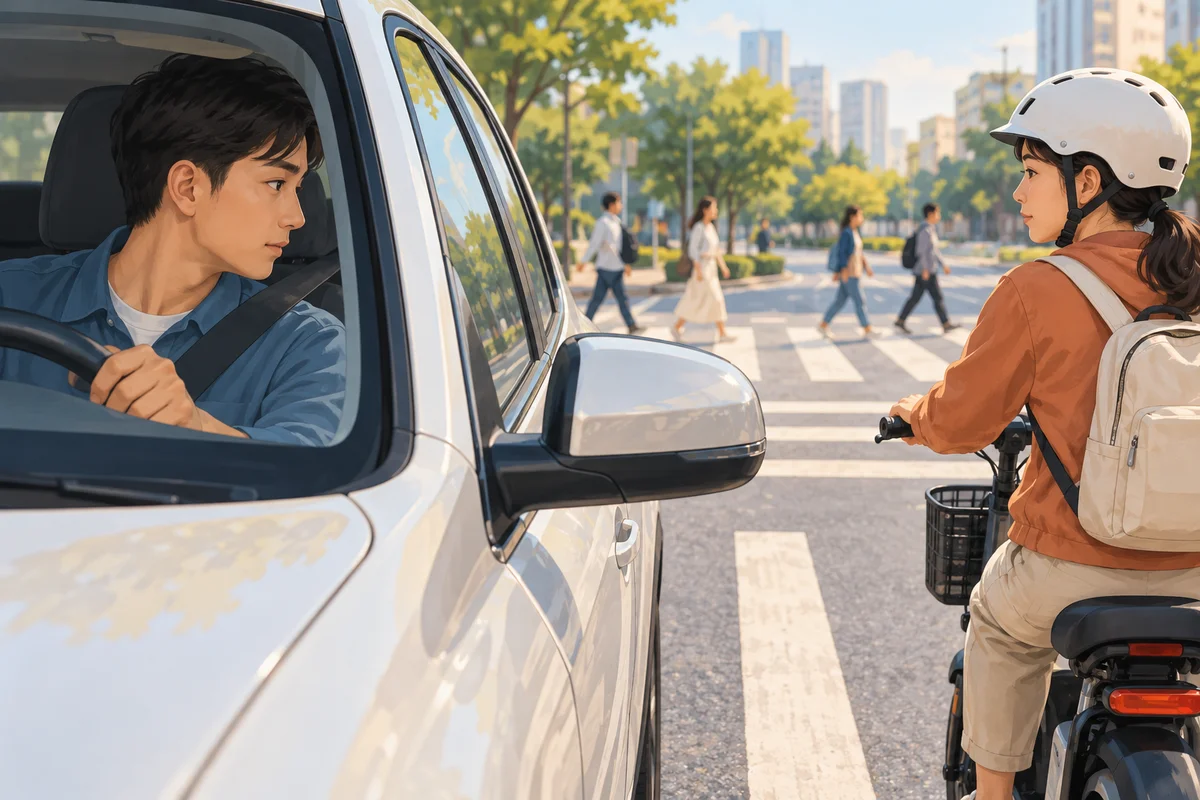
When turning across a pedestrian crossing:
- Reduce speed before the turn.
- Check both the near side and far side of the crossing.
- Watch for bicycles and e-bikes moving straight ahead while you turn.
- Do not assume a crossing is empty just because a large vehicle blocks your view.
- Avoid stopping on a pedestrian crossing or blocking a junction.
Article 47 of China's Road Traffic Safety Law requires drivers to slow at pedestrian crossings and stop to give way when pedestrians are crossing. On roads without traffic signals, drivers must also give way to pedestrians crossing the road. Continue to obey the applicable signals. Look for smaller road users before you turn, not after you have started turning.
5. Lane markings and special lanes
China uses signs and road markings to separate traffic flows. You may see lanes reserved for buses, marked non-motor-vehicle lanes, turn-only lanes and arrows that show which movements are permitted.
Do not drive in a lane simply because it looks empty. Check its signs and markings. A bus lane or other reserved lane may have time or vehicle restrictions shown on signs. A lane that permits a turn may not permit you to continue straight.
If you miss your turn, continue safely and let the navigation recalculate. Do not cross a prohibitory solid line, cut in sharply or reverse to reach the correct lane.
6. Speed limits: do not guess from the road
Speed limits vary by road type and posted sign. A wide road does not automatically mean a high speed limit. Pay attention when entering a tunnel, an urban area, a construction zone or a road with temporary signs.
A few useful comparisons:
- The EU does not have one single set of road rules for every country. National speed limits and other details differ.
- Germany distinguishes motorway advisory speeds from binding limits: its advisory-speed regulation does not replace a posted maximum speed limit.
- The US and Canada have state or provincial rules; follow the signs for the jurisdiction and road you are using.
- Australia and New Zealand use kilometres per hour, but limits and road rules still vary by jurisdiction and road.
- Japan, South Korea, Singapore and Malaysia have their own limits and enforcement systems.
In mainland China, use the posted limit for the road you are actually on. Do not convert a remembered home-country limit into a guess about a Chinese road.
7. Alcohol, phones and seat belts
The safest plan is straightforward:
- Do not drink alcohol before driving in China.
- Do not hold or operate your phone while driving. Set navigation before you move, or pull over safely before changing it.
- Wear your seat belt and make sure passengers do the same.
- Use an appropriate child restraint and check the local requirements and rental-company availability before travelling with a child.
- Do not assume that a rule or alcohol limit from your home country applies in China.
EU member states share some safety requirements, but national rules still differ, including alcohol limits and certain vehicle equipment requirements. Check the rules of the place where you are driving rather than relying on memory.
8. Signs: familiar shapes, but not always familiar information
Many road signs use shapes and colours that international drivers can recognize. However, destination signs in mainland China may show place names in Chinese and pinyin rather than the English names used by your travel app.
Before setting off:
- Enter your destination before moving.
- Check the Chinese name of the destination and road where possible.
- Listen to voice directions, but keep watching the signs.
- If navigation and road signs seem to disagree, do not make a sudden turn. Continue safely and let the route recalculate.
- Learn basic Chinese words such as “entrance” (入口), “exit” (出口), “no entry” (禁止驶入) and “no parking” (禁止停车).
Navigation is a helper, not an authority. A map cannot give you permission to ignore a red arrow, a prohibited-turn sign or a police officer.
9. What if you are involved in a crash?
A crash can be stressful even when nobody is hurt. First protect people and prevent a second crash.
- Stop immediately and prevent further danger. Use hazard lights where appropriate. Do not stand in moving traffic to inspect damage or take pictures.
- Check for injuries. Call 110 for police and 120 for an ambulance when needed; 122 is also a road-traffic accident reporting number. Give your exact location and direction of travel.
- If it is safe, photograph the vehicle positions, damage, number plates, signs and road markings before moving the vehicles. Protect evidence, but put people first.
- Clear an eligible property-damage collision promptly: after safely recording evidence, move the vehicles to a place that does not obstruct traffic, then discuss the damage. Moving out of traffic under this procedure is different from fleeing an accident.
- Report to police where required and exchange names, contact details, vehicle and driving-licence details, and insurance information. Follow police directions and contact the rental company promptly.
- Do not promise payment or sign a document you do not understand. Ask for an explanation; a translation tool can help, but should not be your only basis for accepting liability.
- Keep the photographs, police records, repair documents and insurance communications.
When should vehicles be moved, and when must you call police?
Article 70 of the Road Traffic Safety Law says that a collision causing only minor property damage, with clear basic facts, should be cleared before the parties negotiate. Articles 13–14 and 19 of the accident procedures give the conditions: eligible vehicle-to-vehicle or vehicle-to-non-motor-vehicle property-damage collisions require evidence to be recorded safely and vehicles moved out of traffic promptly.
There are exceptions. Preserve the scene and report immediately if anyone is injured or killed, a driver lacks a valid licence or the right vehicle entitlement, alcohol or controlled drugs are suspected, there is suspected serious overloading or speeding by school/passenger transport, a vehicle has no plate or a fake plate, vehicles cannot be moved, a party has left, or there is evidence of an intentional collision. Move people to a safe place away from traffic. Police may direct how the scene is handled.
For a property-damage collision involving missing inspection/insurance marks, or damage to a building or public facility, Article 14 instead requires safe evidence recording and moving movable vehicles out of traffic before reporting. If you are unsure which procedure applies, call police promptly and explain the situation. Do not keep an otherwise eligible minor collision blocking the road simply to wait for rental-company staff.
If you are driving on a temporary permit, Article 18(5) of the temporary-entry driver rules also requires prompt reporting to traffic police. Call promptly, explain the circumstances and follow the applicable scene-clearance procedure. The rental company may require immediate notification even when damage seems minor. Save its emergency number before driving, so you do not have to search through an app beside the road. The official emergency-number reference is available from Beijing's government service.
10. How the rules differ in countries many visitors know
This is a practical orientation, not a complete legal comparison. National and local exceptions matter.
European Union
The EU does not have one fully unified road code. Some safety requirements are shared, but speed limits, alcohol limits, winter equipment and other rules can differ by country. Cyprus, Ireland and Malta drive on the left; most other EU countries drive on the right. Check Your Europe's country guidance for the country you will actually visit.
United Kingdom
Drivers keep left. Do not assume a red light allows a turn; a separately displayed green arrow can allow its indicated movement when clear. Use the Highway Code's road-position rules and signal guidance for Great Britain. Northern Ireland has its own Highway Code.
United States
Drivers keep right. State and local rules matter. For a named example, California permits a right turn on circular red after stopping and yielding, unless a sign prohibits it; a red arrow prohibits turning. Do not assume that California's rule describes every US jurisdiction.
Canada
Drivers keep right. Provincial and local rules matter. In Québec, right turns on red require stopping and yielding and are prohibited on Montréal Island and wherever signs prohibit them. Check the province and city you will actually visit.
Australia
Drivers keep left. Road rules are administered by states and territories. For example, NSW requires stopping at red lights and red arrows, but permits a left turn on red where a specific sign allows it, after stopping and giving way. Confirm the rules of your state or territory rather than treating this example as a national exception.
New Zealand
Drivers keep left. Stop for a red signal; do not assume a red light permits a turn. Auckland Transport explains the stop-at-red rule. The US government's visitor guidance also confirms left-side traffic and that left turns through a red signal are not allowed.
Japan
Drivers keep left. The National Police Agency's traffic-signal guide says that red prohibits proceeding beyond the stopping point, while a green arrow can permit movement in its direction even when red is showing. Do not assume a signal for another direction applies to your lane. The police also provide multilingual road-position guidance.
South Korea
Drivers keep right, as specified in Article 13 of the Road Traffic Act. Follow the signal for your lane and direction and check current Korean road rules before driving. Do not assume that rules for turning on red are the same as those in the United States.
Singapore
Drivers keep left. The Traffic Police's Basic Theory of Driving handbook explains red lights, directional arrows and a specific Left Turn on Red sign. A red light alone is not permission to turn; a permitted turn still requires following its signal or sign and giving way.
Malaysia
Drivers keep left. JPJ lists failure to obey red signals as a traffic offence. Follow signals, signs and lane markings rather than importing another country's red-light rule. Official US visitor guidance confirms left-side traffic and cautions that a left turn on red needs a permitting sign.
11. A simple pre-drive checklist
Before you leave the rental branch:
- Confirm that your driving document is valid for driving in mainland China.
- Save the rental company's roadside-assistance and accident numbers.
- Check the insurance excess, deposit rules and accident reporting procedure.
- Set your navigation and destination before moving.
- Check that the car has the required documents and equipment.
- Learn how the headlights, hazard lights, wipers and parking brake work.
- Remember: drive on the right.
- At a normal round red light, right turns are generally allowed only if no sign, marking, arrow signal or police direction prohibits them, and you do not obstruct traffic or pedestrians with the right of way.
- A red right-turn arrow means do not turn.
- When in doubt, do not make a sudden manoeuvre. Stop only where it is safe and legal, check the rule, and continue when you can do so safely.
Happier China recommends treating your first drive in China as a familiarisation trip. Choose a straightforward route in daylight before attempting a busy city centre, complex interchange or long-distance journey. If you would rather avoid driving, see our guide to DiDi, taxis and pickup points.
Sources & verification
Last checked by Happier China: Oct 17, 2026
The dates below belong to the source publishers. Check the responsible service’s current instructions when making a booking or application.
- Road Traffic Safety Law (2021 amended text)
National People's Congress; official text hosted by SAMR
Source date: Amended 29 April 2021Source note: host published 3 November 2022 - Road Traffic Safety Law Implementation Regulations
State Council; official text hosted by SAMR
Source date: Amended 7 October 2017Source note: host published 15 June 2021 - Huadu administrative review: right turn through a red arrow
Huadu District People's Government, Guangzhou
Source date: Decision Huadu Fu Xing Fu [2025] 1244 - Procedures for Handling Road Traffic Accidents
Ministry of Public Security; official text hosted by Hubei Public Security Department
Source date: Order 146Effective: 1 May 2018Source note: host 22 October 2021 - Can a foreign driving licence be used in mainland China?
Beijing Traffic Management Bureau
Source date: 9 July 2026 - Emergency telephone numbers in China
Beijing Municipal Government, Japanese-language service
Source date: 17 August 2021
More sources (20)
- Road rules and safety
European Commission, Your Europe
Source date: Source last - The Highway Code: light signals controlling traffic
UK Department for Transport
Updated: 22 October 2025 - The Highway Code: using the road, rules 159–203
UK Department for Transport
Updated: 22 October 2025 - The Highway Code for Northern Ireland
Northern Ireland government, nidirect
Source date: No page publication date stated - California Driver's Handbook: laws and rules of the road
California Department of Motor Vehicles
Source date: Live handbookSource note: no page publication date stated - California Driver's Handbook: navigating the roads
California Department of Motor Vehicles
Source date: Live handbookSource note: no page publication date stated - Turning right at a red light
Government of Québec
Source date: No page publication date stated - Driver's Handbook
Société de l'assurance automobile du Québec
Source date: Second edition, legal deposit 2018 - Traffic lights
NSW Government
Source date: Live guidanceSource note: no page publication date stated - Road User Handbook
Transport for NSW
Publication date not provided - New Zealand: transportation and traffic laws
US Department of State, Bureau of Consular Affairs
Updated: 7 May 2026 - Intersections
Auckland Transport
Source date: No page publication date stated - Traffic Lights and Road Signs
Japan National Police Agency
Source date: Police directory lists update 26 December 2023 - Traffic Safety Rules
Japan National Police Agency and Prefectural Police
Source date: No document date stated - Road Traffic Act, Article 13
South Korea Ministry of Government Legislation
Publication date not provided - Basic Theory of Driving
Singapore Police Force, Traffic Police
Source date: 10 October 2024 file version - e-Aduan@JPJ: traffic offences
Road Transport Department Malaysia (JPJ)
Source date: Service launched 1 April 2022Source note: no later page date stated - Malaysia: traffic laws
US Department of State, Bureau of Consular Affairs
Source date: Live travel guidanceSource note: no date inferred - Motorway Advisory Speed Regulation, section 1
German Federal Ministry of Justice and Federal Office of Justice
Source date: Consolidated statuteSource note: no page update date stated - Temporary-entry vehicles and drivers: duties after a crash
Ministry of Public Security; official text hosted by Beijing Traffic Management Bureau
Source date: Order 90Effective: 1 January 2007
Comments & practical questions
Keep comments practical and relevant. Off-topic political or religious arguments, explicit content, hate, spam or illegal content may be removed. Comments are reviewed before publication. Comment rules.
Loading comments…