
Mainland China · Hotel drinking water
Can You Drink Tap Water in China? A Hotel Guest’s Guide to Drinking Water
A hotel guest’s guide to drinking water in China: bottled water, direct-drinking supplies, kettle checks and the limits of boiling tap water.
You arrive at your hotel in China, put your bag down and want a glass of water.
Can you drink straight from the bathroom tap?
For a visitor, the easiest answer is:
Do not assume an ordinary hotel tap is intended for direct drinking unless it is specifically marked as potable drinking water.
Use sealed bottled water or a clearly marked, maintained drinking-water supply. For normal municipal tap water with no local warning, boiling is another practical option.
That is more useful — and more accurate — than saying that all Chinese tap water is “unsafe.”
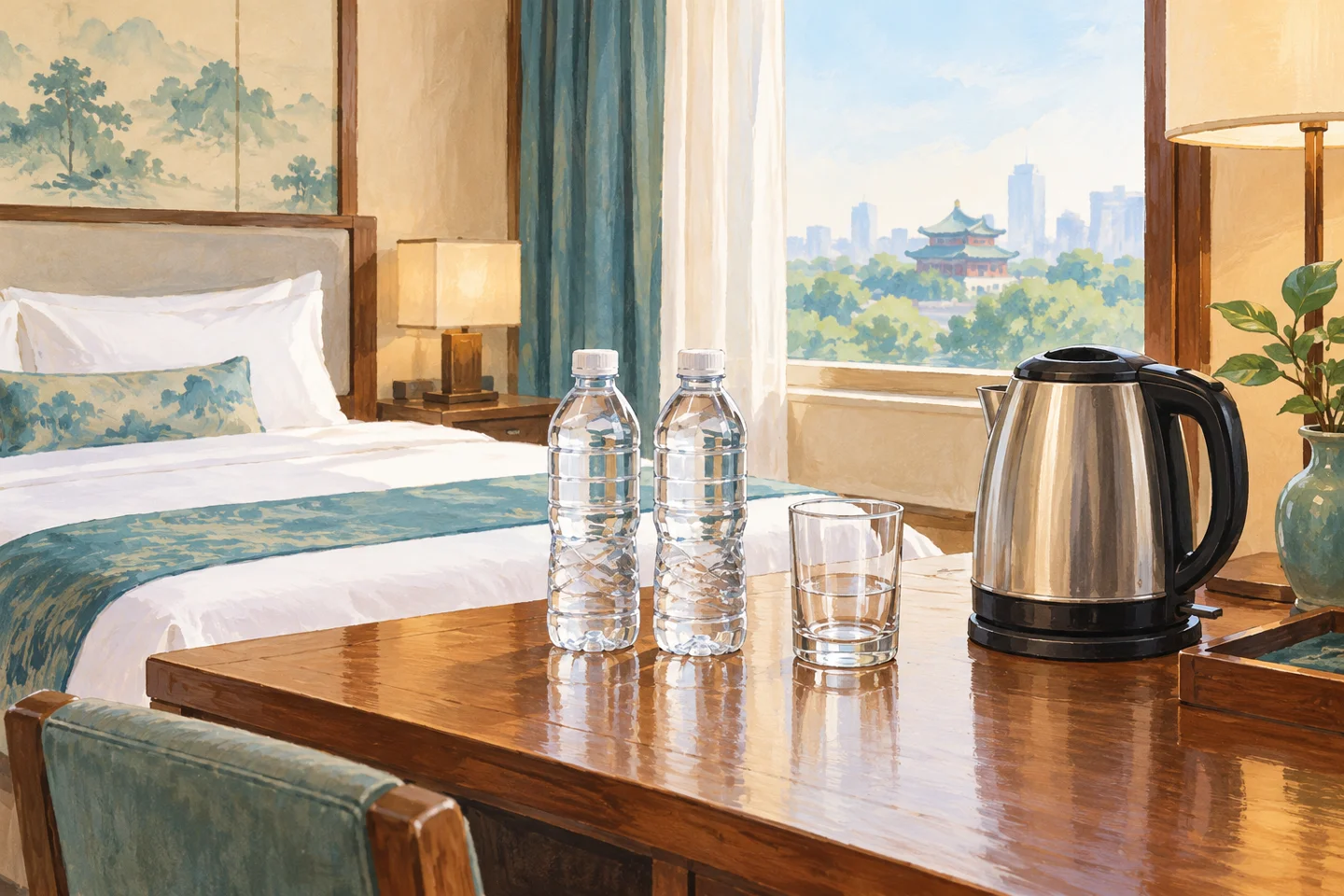
Guangzhou’s municipal water is tested to drinking-water standards
Guangzhou’s water authority publishes regular water-quality results.
For July 2026, the city reported a 100% comprehensive compliance rate for its water supply, in its published monitoring under China’s national GB 5749-2022 Standards for Drinking Water Quality. The published monitoring covered treatment-plant water, distribution-network water and secondary-supply water. 广州市水务局
So the problem is not that Guangzhou simply pumps “non-drinking water” into buildings.
The practical issue is what happens between the municipal system and the glass in your hotel room.
Building pipes, storage tanks, secondary water systems and the condition of an individual property can all matter.
That is why “meets the drinking-water standard” and “I recommend every visitor drink from every tap without boiling” are not the same statement.
Beijing is a useful example
A 2012 interview with Beijing’s municipal water supplier offers a useful explanation of the distinction. It is a historical explanation, not a current nationwide assurance about every hotel.
The supplier explained that municipal compliance and the decision to drink directly are different questions: building pipes, secondary supply and personal circumstances can matter.
Its practical recommendation in that interview was to boil normal tap water before drinking it. 首都之窗_北京市人民政府门户网站
Beijing health authorities also advise drinking boiled municipal water or bottled water during higher-risk situations such as flood periods. 首都之窗_北京市人民政府门户网站
For an international visitor moving from city to city, that leads to a useful rule:
If you do not know the building and the tap is not clearly labelled for direct drinking, use sealed bottled water or ask the hotel about its supply before boiling normal municipal water.
Boiling kills many germs but does not remove harmful chemicals. If there is a contamination warning, unusual colour or a strong unexplained smell, use bottled water and follow the local advisory rather than trying to fix it by boiling. CDC: household water treatment
What about “direct drinking water”?
You may occasionally see:
直饮水 — zhíyǐnshuǐ
That means water supplied specifically for direct drinking.
It may come from a separate dispenser, filtered-water system or dedicated drinking-water point.
Treat that as different from an ordinary bathroom or kitchenette tap.
Do not assume every shiny modern tap is a direct-drinking tap. Ask the hotel if the supply is intended for drinking and whether the equipment is maintained.
If you are not sure, ask:
这个水可以直接喝吗? Zhège shuǐ kěyǐ zhíjiē hē ma? Can I drink this water directly?
Bottled water is the simplest hotel option
If your room provides sealed complimentary bottled water, that is usually the easiest choice.
Check whether the bottles are clearly complimentary.
Water in a minibar or a specially priced hotel product may not be free just because it is sitting in the room.
If you run out, bottled water is easy to find in convenience stores, supermarkets and many hotel lobbies.
You do not need to buy expensive imported mineral water.
Ordinary sealed drinking water is fine for everyday use.
What about the electric kettle?
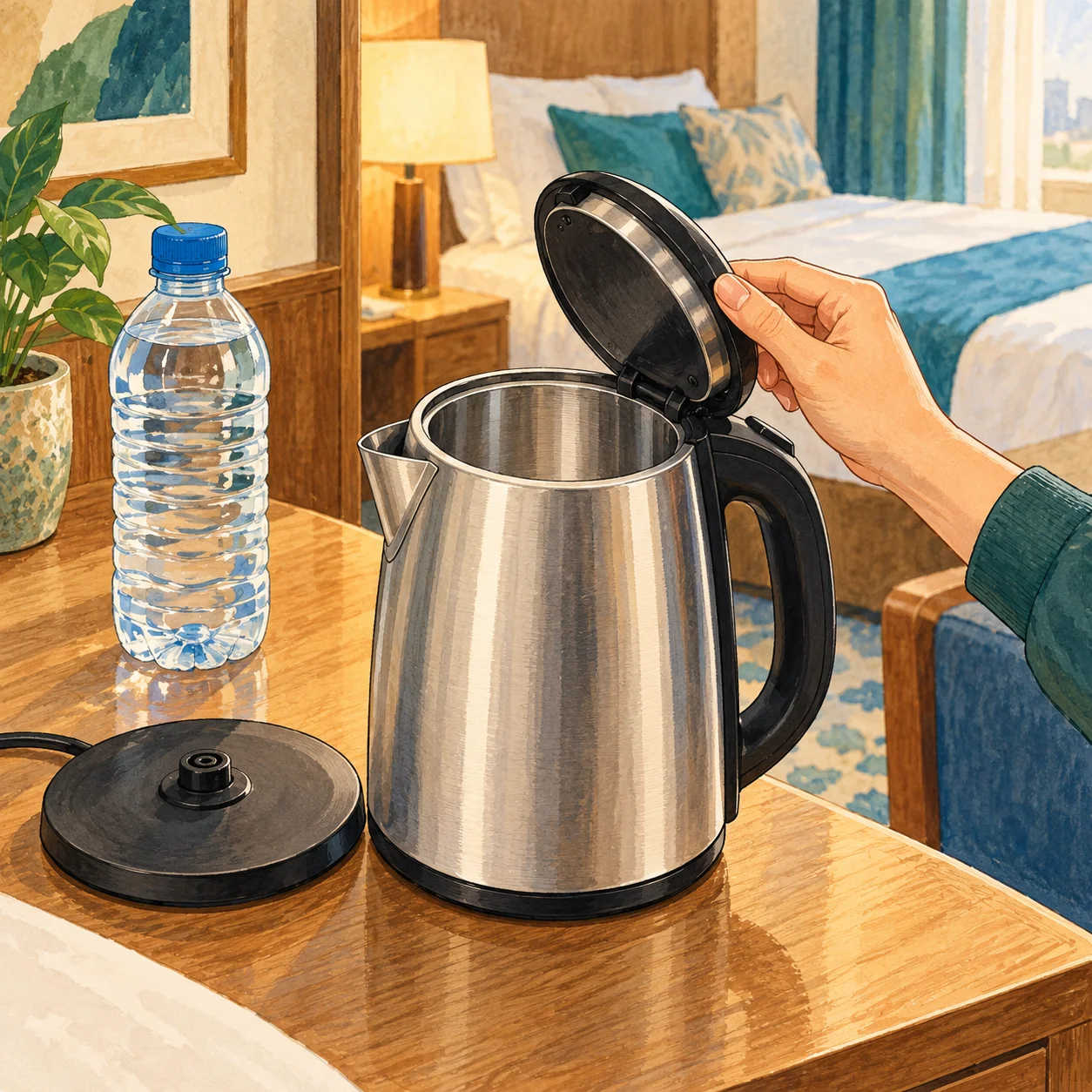
A hotel kettle is useful.
It is also shared equipment that has been used by many strangers before you.
That does not mean hotel kettles are generally filthy.
Just do what you would do with any shared appliance.
Look inside the kettle before using it.
If it looks and smells normal, rinse it with fresh water and follow the appliance instructions. Use fresh cold water from a supply the hotel confirms is suitable for boiling; keep within the kettle’s fill limits. Rinsing and boiling do not prove that an unfamiliar appliance is clean.
If you see oil, food residue, detergent residue, unusual staining or smell something strange, do not try to solve the problem by boiling it five times.
Ask the hotel to replace the kettle, or use bottled water.
White scale does not automatically mean the kettle is dirty
This is another common misunderstanding.
You may see a white mineral layer inside the kettle after water has been boiled repeatedly.
Guangzhou’s water authority explains that this is generally formed from naturally occurring calcium and other minerals in the water. Within the regulated water-hardness limits, ordinary scale is not considered harmful to health. 广州市水务局
So:
white mineral scale ≠ food residue
and
white mineral scale ≠ proof that the hotel never cleans the kettle.
An oily film or unusual smell is much more concerning than ordinary chalky scale.
Why does tap water sometimes smell slightly like chlorine?
A faint disinfectant smell can also surprise visitors.
Guangzhou’s water authority explains that municipal water is disinfected and that residual disinfectant is controlled under national standards. A slight chlorine-like smell by itself does not mean the water is unsafe; the authority says boiled tap water can be consumed normally. 广州市水务局
If the water is visibly cloudy, strangely coloured or has an unusual strong smell, that is different.
Do not drink it.
Call the hotel.
The easiest routine for a hotel stay
On your first night, check whether the room has sealed bottled water.
If you need more, buy a few bottles nearby.
If the building’s supply is uncertain or a local water advisory applies, use bottled water for brushing your teeth too. Ask the hotel about washing and other uses affected by the advisory.
If you want hot drinking water, inspect and rinse the kettle first, then boil fresh cold water from the normal municipal supply if the hotel confirms there is no supply problem.
If the hotel has a clearly marked direct-drinking-water dispenser, use it according to the instructions.
That is usually all you need to think about.
Useful Chinese
Show this to staff, or play it if your device has a Chinese voice.
Mineral water
Drinking water
Direct drinking water / potable drinking water
Can I drink this water directly?
Can you replace this kettle?
Please give me two more bottles of water.
Sources & verification
Last checked by Happier China: Oct 16, 2026
The dates below belong to the source publishers. Check the responsible service’s current instructions when making a booking or application.
- Guangzhou water-quality results: July 2026
Guangzhou Water Authority
Published: Aug 25, 2026 - Municipal water and direct drinking: supplier interview
Beijing Municipal Government portal / municipal water supplier
Published: May 31, 2012 - Flood-season drinking-water advice
Beijing Center for Disease Prevention and Control / Beijing Government portal
Published: Jul 10, 2025 - Why a kettle develops white scale
Guangzhou Water Authority
Published: Mar 12, 2025 - Why tap water can smell of chlorine
Guangzhou Water Authority
Published: Jul 11, 2023 - Household water treatment and its limits
US Centers for Disease Control and Prevention
Published: Apr 22, 2024
Comments & practical questions
Keep comments practical and relevant. Off-topic political or religious arguments, explicit content, hate, spam or illegal content may be removed. Comments are reviewed before publication. Comment rules.
Loading comments…